I went chasing rabbits instead of Omicron over New Year's weekend. My constant and faithful companion was chocolate in obscene amounts. Self-loathing accompanied the binges and was drowned in endless eggnog coffees. My beloved Buckeyes won the Rose Bowl in Pasadena, California, against a bunch of state school Mormons from Utah. Indoor bike races everyone claimed to win happened here and Monopoly games I escaped took place in the evenings.
I hope your weekend was smashing.
The road to Joan Huntington was a big circle. Inside the Manson Gang (2007)was the first stop. Manson from 1973came next, out of order like Matthew and Mark, after I found myself unable to stop asking why the girls would say some of the things they said. Both films could be alt titled: How To Ensure You & Your Friends Remain Proper F*cked Forever.
There's a moment early on in Inside where one of the girls says something like I've been thinking about letting someone believe they're making one movie but it's actually another movie. Outside of that single line as a possible motivator, I was baffled. Knives? Davey Crockett rifles? The Neverland outfits?
Dudes. Ya gotta know they're playing you. And Nancy stop digging in your ear.
The girls did not realize what they were up against. Too much naive faith in their mojo maybe and steep prices were paid for sure. Just an all-around terrible idea. Their parents must've thought they lost their minds.
A double shot of Hendrickson drove home how important the filmmaker is to the foundation of this study. I'd prefer a comedy voiceover on the 2007 edit but then I'm cynical. Either way, his footage and interviews remain huge in this community five years after Hendrickson's death.
Some in our community agree with Hendrickson's take on the Family and others are offended. The offended folks always mention the film had a script and the girls read from them. Again, why? And who wrote the script?
Hendrickson says in the 2007 film that financier Laurence Merrick and his people joined when the project was half completed. Merrick was older and from Israel. That might be him doing the weird Charlie voiceover sounding like an Israeli who watches Cheech and Chong movies. Hendrickson was twenty-seven or twenty-eight and the Spahn's Ranch kids confused him even though Mary and Gypsy were contemporaries, and he does not have a writing credit anyway.
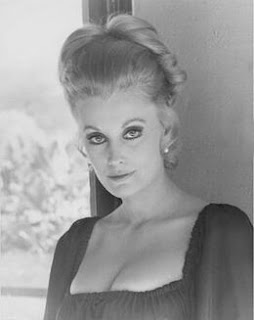
Enter Joan Huntington. Only her and Merrick are listed as writers on Manson.
Huntington passed last June. She was nine years older than Sharon Tate but did the same beautiful women spots in Los Angeles sitcoms and tv shows. Beverly Hillbillies and so on.
Huntington's husband, Laurence Merrick was mortally wounded in the parking lot of his business by a crazy man who believed Merrick and others performed a black magic ritual on him during a class held inside the building. Because Merrick ran an acting school, everyone assumed he was acting when he crashed through the door announcing he was shot.
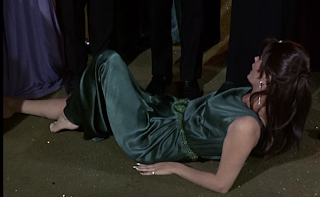
Some of Huntington's one liners in Hendrickson are as good as any top action film. She was a smart lady who might've helped the victims get a bit of long-term revenge. Please enjoy this screen cap of Huntington's tail right after she changed from a cat to a human on Season 3 Episode 7 of tv's Bewitched. I thought the tail would disappear with the rest of her cat parts but it did not and no explanation was offered.
Nosy Gladys Kravitz across the street sees the cat change into Huntington's character, Eva, and calls in two city council members to investigate. Links to the full version and a shortened version are below. Here is thirty-two year old Huntington at the feet of Paul Lynde (OHIO!), Dick York, and Elizabeth Montgomery.
The Say Hey Kid Willie Mays is in this episode too. Turns out he's a warlock or whatever male witches are called in the tv show. Mays zaps himself away from a Halloween Party at just before midnight to "the ballpark." Elizabeth Montgomery tells Dick York that's the reason Mays hits so many home runs. The scene is edited out of the shorter version below.
Honorable Dick York resisting the advances of Huntington. What a guy.
Big problem. Just like Cinderella, Huntington turns back into a cat at midnight, and Elizabeth Montgomery keeps her marriage.
This episode aired the week of Halloween, 1966. America remains number one although internal discontent bubbles and burps. The draft lottery is three years in the future but almost half a million Americans are in Vietnam and offshore. Six thousand Americans will die in Vietnam in 1966, and the US government will claim sixty-one thousand Vietcong deaths.
Charlie strums his guitar at Terminal Island. Mary shelves books while Squeaky avoids her father while Dennis avoids his father. Bewitched finishes in a three way tie for seventh highest rated tv show of the year along with two other programs Huntington guest stars on, Daktari and Beverly Hillbillies.
Bigger picture, Huntington is half a decade away from a writing credit on an Oscar nominated documentary that will help shape American history. Wild.
+ggw
-------------
Bewitched S3E7 edited but better player on IMDBtv.
Bewitched S3E7 full episode but small player on Youtube.
Episode fan page with continuity errors. Did you notice Boris was inside the party before arriving at the party?
Laurence Merrick's Black Angels -- about a white motorcycle gang versus a black motorcycle gang in a film simply jam-packed with absurdities, semi-authenticities, and some ass-kickin' action! — is now streaming as part of our Something Weird collection on Night Flight Plus!
Laurence Merrick didn't direct too many movies, and he's actually probably best known for co-directing the legendary 1972 documentary Manson with Robert Hendrickson, which featured interviews with the Manson Family before and after the shocking murders that rocked the nation in 1969. It ended up garnering an Academy Award nomination for Best Feature-Length Documentary.
Merrick was also well-known in Hollywood for his acting school, the Merrick Studio Academy of Dramatic Acting, and for the fact that one of his students, Sharon Tate, would later be killed by members of Manson's Family, during August of 1969, the same year he spent fourteen days directing Black Angels.
In fact — in yet another example of the parallels that existed between Southern California's biker and hippie countercultures -- members of Manson's Family would occasionally drop by Paramount Ranch, located at 2813 Cornell Road, in Agoura, California, and visit the set while Merrick and his cast and crew were filming scenes.
(The same thing also happened during the filming of The Girls from Thunder Strip at Spahn Ranch, which is now part of Santa Susana Pass State Historic Park, where members of the Family would drop in at lunchtime and beg for food from the production crew and cast... we told you about that here).
In 1960, Merrick — who served in the Army of Defense for Israel — was sent to the U.S. to speak in support of Zionism, and while he was fundraising in New York City, he met his future wife, a dark-haired aspiring Broadway showgirl and wannabe actress named Joan Huntington.
Together they came out to the west coast, and set up the Merrick Studio, located at 870 N. Vine St. in Hollywood, California, and for a time it was an inexpensive place for actors (like the great Geoffrey Lewis!) to learn lessons about their craft.
The Merricks were subsidized by the government too, which enabled them to make a lot of money running the school. They bought a nice house in Beverly Hills and then decided to put their studio profits towards making their own movies, which they could then cast with students from the school, a win-win situation for everybody.
Merrick's wife — who continued with her acting career, and was nearly chosen to play Morticia on TV's The Addam's Family -- came to see the movies they were making as training exercises, while her more business-minded husband thought more about the potential financial windfall for their production company, Merrick International Films, selling the films to distributors for even more big bucks.
He also liked the fact that since he had no one bossing him around, he could be as experimental as he wanted, since he didn't have a movie company or studio head interfering with his creative process, and so he applied his experimental ideas, mainly to the camerawork, on each of the films he shot.
The Merrick's first project, made in late '68, was what Merrick would later refer to as a nudie cutie, a relatively plotless short film that featured three buxom housewives on the prowl for men. It wasn't very good, and Merrick didn't even bother to give it a title or a credit sequence.
Their next effort, an odd little vampire movie called Guess What Happened to Count Dracula?, fared better than their short nudie cutie, although Merrick was so inexperienced that he didn't realize he was supposed to say Action! at the beginning of every scene and was surprised to find his cinematographer, Robert Caramico, waiting on him to do so in order to begin operating the camera.
The movie featured several of Merrick's students in key parts, and chiefly concerned what happened to Dracula's son, Count Adrian (Des Roberts, who plays the vampire while sporting a wicked John Carradine-style goatee). Roberts and his musical partner, Andy Wilder, also provided the film's musical score.
The film was shot at the Magic Castle in the Hollywood Hills, a mansion built in the 1920s which had been renovated for performances by magicians.
One of Merrick's students owned the place, and had invited Merrick and his wife over for dinner, which left a lasting impression, and when the couple began thinking of locations where they could shoot their Dracula movie, they both remembered the Magic Castle, which was just about to undergo a renovation.
As you might expect, quite a lot of the movie is devoted to magic tricks performed by members of the Magic Academy, the castle's troupe in residence.
The movie also contains a subplot straight out of the then recent box office smash Rosemary's Baby, when one character -- an actor named Guy (just as John Cassavetes's character was in Roman Polanski's film), played by John Landon -- is all too willing to sell his soul in return for being given a successful acting career.
It's also interesting to note that Merrick's film features a surprise ending that was clearly inspired by Polanski's previous film, 1967's The Fearless Vampire Killers, or Pardon Me, But Your Teeth Are in My Neck, when Polanski's future wife Sharon Tate sprouts fangs in the film.
Merrick's Dracula movie was later released in Europe in an adults only version which featured more nudity and sex, courtesy of performances by Olga Copa and someone named Horror-Charlie.
The additional nude scenes were shot by Mario d'Alcala, who was given the sole credit as director for the European-distributed version of the film on the poster. The film was in distributed in Germany as Lüsterne Vampire, and in France as Dracula Vampire Sexuel.
For his next film, Laurence Merrick realized that outlaw biker flicks were all the rage, and so he began developing the film which we present to you here on Night Flight Plus.
Wanting to also cash in on the fairly new phenomenon of Blaxploitation, Merrick's script focuses on two biker gangs at each other's throats, a white motorcycle gang called Satan's Serpents — led by Chainer (once again played by Merrick's favorite leading man, Des Roberts) — and a black motorcycle gang, called the Choppers (their leader was played by Bobby Johnston, whose biggest role previous to this one was as a prison guard in In Cold Blood).
The film's title, Black Angels is actually the name attributed to the highway patrolmen who observe the two rival biker gangs from a distance, waiting for the race-motivated war for turf to explode.
Merrick recruited a real black biker gang to play the Choppers in order to provide authenticity.
The main plot concerns one Black Angel in particular -- a lieutenant for the highway patrol named Harper (Clancy Syrko, who also edited the film) -- who wants to see all of the biker gangs wiped off the the face of the earth, and he plots to pit the two gangs against each other so they will end up in a race war leading to both of them being destroyed.
A renegade racist Southern biker named Johnny Reb (John King III) is just the man to help Harper have his wish fulfilled, and he becomes a member of the Serpents after Chainer kills a black biker, which, of course, sets the two gangs on a mission to kill each other as fast as possible.
Reb starts spouting off racist slurs when the Serpents stop off to have a beer and are served by a black waitress, but that's when Chainer tells him their conflict with the Choppers is over turf, not skin color.
Chainer then gets to deliver the movie's best line: This country is getting so you can't have a decent fight with a black man without somebody making it out to be about race.
When the Choppers nearly kill the Serpents' leader during an ambush, Reb ends up saving Chainer's life, and this calls for a party, only they find out too late that the bag of pills that Johnny Reb has handed out at the party aren't uppers, they're downers, sending the Serpents on a bummer of a trip.
Reb almost gets away with the sabotage it until a biker named Frenchy (John Donovan) reveals to Reb that he knows what's going on, but Frenchy pays the ultimate price for telling Reb what he knows, which then stars a white-on-black biker race-driven battle for turf while Lieutenant Harper looks on from atop a hill in the distance.
It's interesting to note that this film's concept of pitting white against black in a race war, in the year 1969, is very similar in some respects to Manson's concept which he called Helter Skelter, an apocalyptic war arising from racial tensions between blacks and white, which he believed was foretold in Chapter 9 of the book of Revelations in the bible (as well as hidden messages he believed he heard in the Beatles' Revolution #9).
Makes you wonder what kinds of conversations they were having at Paramount Ranch between members of the cast and crew and some of Manson's followers.
There were also many interesting cameo appearances, including a real member of Charles Manson's gang, Mark Ross (he plays Singer), who later claimed to write a theme song for the film that was never used (the original rock music soundtrack contains several decent instrumentals and songs in assorted styles, some performed by Smokey Roberds, previously of soft rock band The Parade).
There's also an appearance by Merrick's oldest acting student, Sumner Spector, who also appeared in the 1971 Warren Oates film Chandler.
An interesting sidenote is the fact that one of the bikers happened to have a cougar as a pet, and the Merricks thought it would be fun to put the big cat in a scene or two (their previous film, Count Dracula?, had also featured a similar appearance by a big cat). Merrick's wife was a little concerned about the presence of a cougar on set, as she'd brought their nine year old son Adam to the Paramount Ranch location, and sure enough, the cougar did jump at their son.
Merrick — who shot the film in and around Paramount Ranch, and some surface streets in L.A., in just fourteen days -- experimented even more on Black Angels than he had on Count Dracula?, adding subjective shots from a biker's P.O.V. which give the viewer the feeling they too were hurtling along on the highway on a motorcycle.
He also sped up a chase scene at the beginning of the film which makes the entire world look like it's comically spinning in fast motion.
The film features all kinds of pissed off biker-on-biker punchouts and Evel Knievel-ish action scenes, lots of horizontal topless biker babes (slightly NSFW) and just about anything else you'd expect from a low-budget 70s biker film shot on a shoestring budget.
The film's tagline God forgives, the Black Angels don't!, incidentally, was borrowed from the hugely successful 1967 Italian spaghetti western, God Forgives… I Don't.
Another tagline — and perhaps another reference to Manson? -- was A portrait of the family.
Speaking of Manson and his family, again, it was during the film's production that Merrick was invited to head over to Spahn Ranch, with a 16mm camera, in order to film the Manson family on their own turf.
Merrick also shot footage of them at Devil's Canyon, their Barker Ranch hideout in Death Valley, and then later — during the Manson trial — at the Hall of Justice in downtown Los Angeles, in addition to other locations.
Much of this footage would end up being included in the 1973 documentary Manson, which is why Merrick initially shared the director credit with Robert Hendrickson (who these days doesn't mention Merrick on the film's official website, but this original poster lists Merrick as the film's sole director).
Years later, Manson was banned from being screened in the U.S. by order of Judge Thomas McBride, the District Court judge presiding in the case of Lynette "Squeaky Fromme" -- who had attempted to assassinate President Gerald Ford -- in order to preserve Fromme's constitutional right to a fair and speedy trial. Hendrickson became and still is the only U.S. citizen to have had his U.S. Constitutional right to “free speech” set aside.
The legal matter was taken by the ACLU to the Supreme Court. In 2001, Manson was the subject of the Federal Court’s “first impression” decision regarding the legal interpretation of liability under provisions of the Digital Millennium Copyright Act (the DMCA).
After Manson lost the Academy Award to the fundamentalist exposé Marjoe (about televangelist turned b-movie actor Marjoe Gortner, another Night Flight fave), Laurence Merrick became the first president of Independent Screen Producers, Inc., a film market intended to promote independent filmmakers.
It later grew into the largest film market in the world, and today is called the Independent Film and Television Alliance.
Then, in 1977, Merrick's life would intersect fatally with a potential acting student named Dennis Mignano, who — much like Manson himself — had really wanted to have a music career, but when that didn't pan out, the struggling rock singer decided to take acting lessons.
That decision had led him straight to Merrick Studio -- which by now was teaching classes in acting, directing and cinematography -- where he applied to be a student.
He believed that Merrick — due to his association with Manson, bikers, and magic — was the perfect person to help him launch a successful acting career (Mignano had reportedly been obsessed with magic as a child).
Mignano filled out an application to be a student, and then was told he was eligible for government assistance to pay for his tuition, but he had to wait for three weeks for the application to be processed.
Mignano grew irritated and felt like the delay was yet another setback and a disappointment, but he waited, and while he did so he watched episodes of a 1976 TV mini-series called "Helter Skelter", which just happened to be re-airing on TV.
The TV series may have played a small part in reminding him that his life was now intertwined with Merrick's and he then became obsessed with the idea that Merrick had actually placed a curse on him.
On January 26th, 1977, he went to the school and waited in ambush for Merrick to appear in the parking lot for a few hours and then pulled out a pistol and shot 50-year old Laurence Merrick in the back.
Mignano then fled the scene, and much like the opening scene of Richard Rush's 1980 action film The Stunt Man -- which, and get this, starred actor Steve Railsback, who had played Charles Manson in the "Helter Skelter" mini-series — he, by pure chance, happened upon a movie being shot mere blocks away, on Willoughby Ave., and the killer blended in with the crew (just as Railsback's character did), pretending to be part of the film production team.
Merrick, meanwhile, staggered into his office at the studio, telling his student's "Some son of a bitch shot me and I don't even know why"! Some of the students thought they were witnessing an impromptu acting exercise, but quickly realized that their teacher was dying in front of them.
Merrick was rushed to Hollywood Presbyterian Hospital, but he was pronounced dead within an hour. Students at the Merrick Studio Academy of Dramatic Arts said that Mignano had been hanging around the building all morning, asking them questions about Merrick and his Manson documentary.
I'm sure many of you have seen this poster from Robert Hendrickson's Academy Award nominated (1973) documentary, MANSON. The accompanying article from the San Francisco Chronicle from January 16, 1976 explains the ban.
The damaged and taped-together photo was given to me by Robert. He said that Joan Merrick was a very attractive lady, and that Bugliosi could not keep his eyes off of her when they met to discuss the documentary.
The Col asked in his debut post at this blog if Laurence Merrick's killer, Dennis Mignano, was still living. The answer to that question is, yes. He is 68 years old and lives in his deceased parents home in San Jose CA. I did a little fact checking primarily on the three things that the article seemed to say contributed to Mignano killing Laurence Merrick. The three things were the Mignano home burning down while he was in high school, the murder of a cousin and the murder of his sister. This is what I found.......
Dennis Mignano was born September 30, 1947 in Santa Clara County CA.
His parents were Peter (Pete) Mignano and Rose Marie (nee Campagna) Mignano. The family was living on N. 14th Street in San Jose in 1947 when Dennis was born. They continued to live there until 1956 when they moved to Linda Vista Street in San Jose the year that Dennis's sister was born. Dennis still lives in this home. It's the home he lived in while going to high school. When looking up the home on the real estate sites they all say the home was built in 1955. While there may have been a fire in the home, it's doubtful that it "burned down" because if it was a total rebuild the year it was rebuilt would be reflected in the home's history on the real estate sites.
Here are two screen captures of the San Jose City Directory. It looks like originally the homes on Linda Vista Street were given house numbers with five numbers. The 1963 image, when Dennis would have been in high school, shows this. In 1972 all of the homes on Linda Vista began to be re-numbered from five digits to three digits. Looking at the available years of directories it seems that the Mignano's and one other family, the Autry's, were holdouts until 1976. By then all of the homes had three digit house numbers. Not only that the cross streets were re-named. This was confusing and I wanted to be certain that the Mignano's were definitely in the same home so I went over each householder name and found quite a few of the same names in the 1963 and 1976 directories. I put green tick marks beside the names of residents on the 1963 directory screen cap who also were listed in the 1976 directory. This anomaly could make it appear that the Mignano's moved to a different home by the time Dennis murdered Laurence Merrick when in fact they did not.
I used censuses and family trees at Ancestry to determine who Dennis's cousins were, there were plenty and I stuck to first cousins when trying to figure out which cousin could have been murdered. I could come up with only one cousin who had died in the years before Laurence Merrick was murdered. His name was Gerald James Campagna, his father and Dennis's mother were brother and sister. I was able to find a newspaper article published at the time of his death. The article gives the boy's name as Terry Campagna but I believe this is a typo and should read Gerry. The age of the boy in the article matches the age of Dennis's cousin and the date of death is the same in the article and the California death record.
The trouble with this is that Gerry was not murdered, he was killed in a car accident. The words killed and murdered are interchangeable in some instances but they should not have been in this instance. However, the cousin did die at 15 years old in a rather grim way when Dennis was just shy of 9 years old. It could have been traumatic for him.
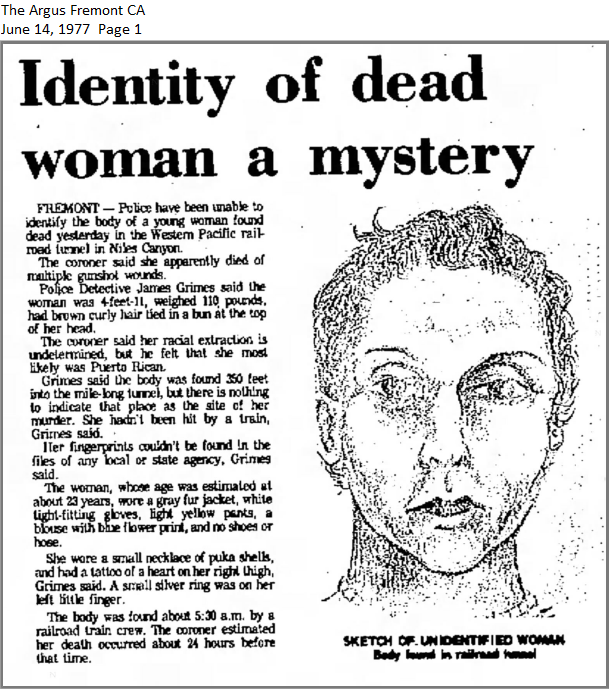
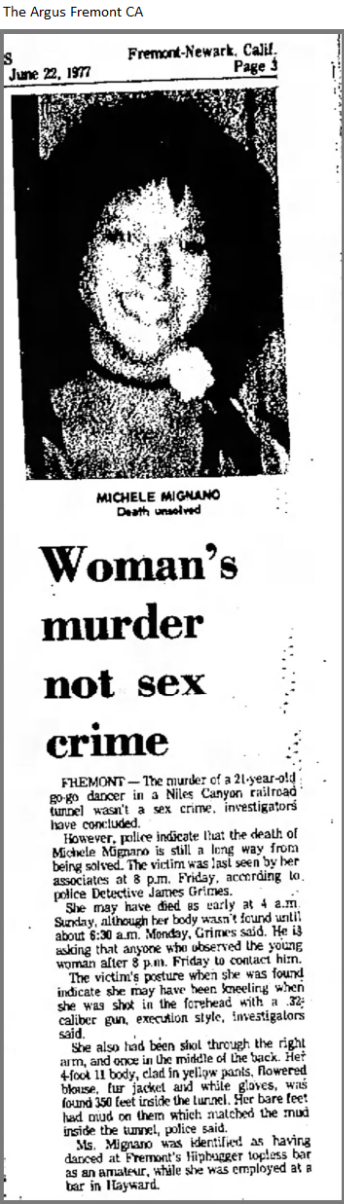
The death of Dennis's sister was a straight up murder and she did hang out with bikers and even danced topless at a bar. While her murder was certainly tragic it did not happen until six months AFTER Laurence Merrick was murdered. The murder was never solved. To my knowledge no one was even arrested though a couple of Hells Angel's were looked at. Given Dennis's mental state during that time, if I were law enforcement, I would have gone back and looked at him for killing his own sister. Maybe they did, who knows?
No matter what I tried I could not get this image larger
I was not able to find any pictures of Dennis Mignano, no high school pictures or pictures taken at the time of his arrest. I was able to find a high school picture of his sister Michele though. She went to Piedmont Hills High School, it's a 10th grade picture from the 1972 yearbook.
On to more current information. I did a background check on Mignano and was surprised that his arrest for murder in LA County shows up.
There were also two other cases involving Mignano on the report but other than providing a date and case number for each event there was no other information. Both of the cases were in Santa Clara County. I tried going to the Santa Clara County Superior Court website but their criminal online information only goes back to 2004. One of the cases had a date of January 9, 1998, the other October 2, 1998 and they had two different case numbers which leads me to believe they were separate cases.
I was able to find one civil case for harassment against Mignano. This was initiated in 1997 and disposed in 2007. I have redacted the woman's name.
I could find no indication of what Mignano does or did in the way of employment. I could not find any email address or social websites connected to him. He has no online presence as near as I can tell. He is not connected to any addresses other than the one family address that has been his since he was nine years old in 1956.
Mignano's father Pete died July 30, 1989. His mother Rose died May 23, 2011, her obituary is brief.
Look - my first guest post and my first blog post in God knows how long !!!
Back in the day I would buy like 20 magazines a week. Now in our fast internet world I maybe buy 20 in a year.
FilmFax is a pretty obscure film magazine that comes out 3 or 4 times a year. This article is from the latest issue.
They don't really address the Manson Doc very much at all. They do call Watkins an "actor" in one pic.
We learn more about the murder of Laurence Merrick than I ever knew. We learn that the insanity defense actually used to work- this crazy fucker did only 4 years for murder. If only the girls had tried it!
We see very little about the documentary, no mention of our esteemed friend Robert and lots of words from Merrick’s widow. I hope Deb S can tell us what happened to the killer after release, is he still with us?
The Col is pleased to share it with the readership of the best remaining active, if Unofficial, TLB Blog.