Showing posts with label Leno LaBianca. Show all posts

Sunday, February 13, 2022

Leno LaBianca's Safe

 
This is hungry work.

Apologies to Hozier. A Super Bowl feast is cooking behind me while I type and I want all of it now. Thanks for letting me hang out with you today and also for my continuing education. 

- Let's also take a second to recognize the Col apologizing to Grim last week and Grim being all okay thanks we're cool. Tears flooded my eyes and I don't mean fake Sadie Mae Glutz ones. This bitter Manson world needs more of that. 

*Begins trashing others. 

Not really. I bring just a single question, a handful of photos, and several screen caps into the Colosseum today. Before we get started, let's give a quick shoutout to the almighty cielodrive.com for providing us with with both LaBianca Homicide Investigative Reports for our discussion.


Last week, I gleefully dove into a new rabbit hole hoping to land on a police document verifying the claim that an office safe at a Gateway Market store was wide open the morning after the murders of Leno and Rosemary LaBianca. Neil Sanders adds the safe at Rosemary's dress shop to the list of opened safes. 

My gut feeling is all roads lead to Bill Nelson and the safes are nothing more than an often repeated opinion, but I'm wrong a lot and want to ask you blog readers. Do any of you have a police report that details open safes at LaBianca businesses the morning after their deaths? I failed in my quest to find one.

Being a rube scoot, I also learned Leno ran a second family company during the same search. This is from the 2nd report linked above. I broke the word salad into readable segments and fixed a couple of typos. 

Peter DeSantis, Leno's other brother-in-law, was interviewed and polygraphed at Parker Center. The polygraph exam indicated he had no guilty knowledge of the crime. 

DeSantis has been a lifelong friend of Leno and described him as "family." They worked together at the market for Leno's father in the '40's. Leno later ran the operation of State Wholesale Grocers, a second company owned by Leno's father. Smaldino, another brother-in-law, ran the Gateway Market chain. When Leno's father died the two companies were then managed by Leno, although they remained separate. 

DeSantis believed Smaldino resented Leno's being the boss as he, Smaldino, knew more about the business. Smaldino kept a constant check on Leno's activities in the business and Leno resented Smaldino's 'supervision.' 

Leno once commented to Norwood, when discussing how he was taking money from the company by writing checks, that he couldn't have done it when Smaldino was around because Smaldino checked him too closely. Leno's mother was the first to tell DeSantis about Leno taking money from the company. DeSantis claimed he was shocked, as the two had discussed ways to cut expenses to help the company. 

Leno told DeSantis in June 1969 that he was going to leave the company. DeSantis discussed Leno's future plans with him. Leno told DeSantis ha had no definite plans for employment. He mentioned going into an investment situation with three other men. Each man was to put up $25,000. The only man in the group that Leno mentioned was Bill O'Brien. 

After Leno's death, DeSantis learned he was planning to buy a ranch for $127,000 in Vista, California. DeSantis couldn't understand where Leno was to get the money to purchase the property, pay back the money he had borrowed from the company and go into the investment business. 

DeSantis is the regional head of a fraternal organization, The Sons of Italy. The region extends from Colorado to Hawaii. DeSantis refused the idea that the Mafia could have been responsible for the crime. He commented that if they had, he would probably have heard about it.

"Are you trying to get me killed?" - DeSantis

My brain wheezed into action. DeSantis is high up in the company. Is he the number two guy behind Leno? Why didn't DeSantis say anything about empty safes to investigators? If not him, who found the safe open and at which store? Which executive handled the matter with the police? 

And where is the police report? 

Off I went. The First Homicide Investigation Report misidentifies Rosemary's dress as a peignoir. 


That's a cropped photo of Rosemary. She's on her stomach and her dress and nightgown are pulled up over her head. Leslie destroyed her. The photo alone seems like it's enough to doom you forever if someone repeatedly shoves it into parole board folders prior to hearings. 


That's Manson in Emmons. Same source for the following. 


          Two quick takes from the above. Charlie hands Rosemary her dress for the sake of modesty, and Charlie declines Leno's offer of a trip to his store for more money. "All you want."

Common arguments against Emmons include Charlie split with the author when Emmons revealed too much, or when Emmons was outright lying. If what Charlie told Emmons is correct, he never considered removing Rosemary from the home. 

Three decades later, Author Neil Sanders -- in a book many call a ripoff of Schreck -- concludes Rosemary left with her hit squad because of the dress and where the boat was found. 

[Note: When Schreck's book arrives, I'll be back to compare the two. But for now, all I have in my library is Neil Sanders.]
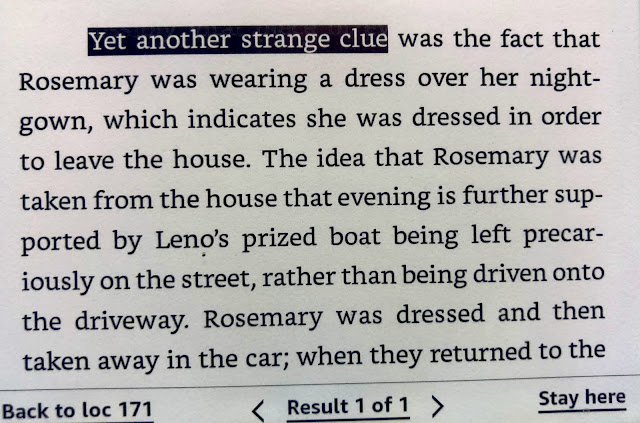


Anyone with a link or recording of Charlie saying they took the LaBiancas to their stores that night, please send it along. More from Neil Sanders:


Let's check the source on that. From Bugliosi: 

Rosemary LaBianca was lying face down on the bedroom floor, parallel to the bed and dresser, in a large pool of blood. She was wearing a short pink nightgown and, over it, an expensive dress, blue with white horizontal stripes, which Suzanne would later identify as one of her mother’s favorites. Both nightgown and dress were bunched up over her head, so her back, buttocks, and legs were bare. Cline didn’t even try to count the stab wounds, there were so many. Her hands were not tied but, like Leno, she had a pillowcase over her head and a lamp cord was wrapped around her neck. The cord was attached to one of a pair of bedroom lamps, both of which had overturned. The tautness of the cord, plus a second pool of blood about two feet from the body, indicated that perhaps she had tried to crawl, pulling the lamps over while doing so.

Okay, cool. Bugs is about to mention the ride to Gateway and the dress shop, right? Let's keep reading. 

A second pink DOA slip was filled out, for Mrs. Rosemary LaBianca. Joe Dorgan had to tell Suzanne and Frank.

There was writing, in what appeared to be blood, in three places in the residence. High up on the north wall in the living room, above several paintings, were printed the words DEATH TO PIGS. On the south wall, to the left of the front door, even higher up, was the single word RISE. There were two words on the refrigerator door in the kitchen, the first of which was misspelled. They read HEALTER SKELTER.

Nope. 

The guy with the biggest book in the study never mentions a trip to Gateway. Why would Sanders include that info in his argument? Bugs never mentions it. 

I'm not a Bugliosi fan in any way. In fact, I'm the opposite. But it's worth mentioning the safes were not a part of the main discussion back in the 70's like they are today. 

Without a police report, what other empirical evidence exists that Rosemary wearing a dress, and a boat in the street, equals the Manson gang took Rosemary to her and Leno's businesses and left the safes open? And how is the evidence verified? 

The safes are enduringly fascinating. Proving it either way might mean a change on the mountaintop if someone is hungry enough. In the background, the argument has raged for more than a decade across Internet sites and in true crime books. Here's our Matt arguing with Starship on LSB so long ago. 

Matt said...
Starship, it wasn't just an article, and I don't believe that it's "bullshit."

Leno, at the time he met Rosemary was relatively wealthy and stood to inherit a great deal when his mother passed away.

While married to Leno, Rosemary is still sleeping with Frank Struthers and Reba Gage. After the murders, Frank Sr. tells police that Frank Jr will be coming into a large inheritance from his mother. Later, Frank Sr. accuses Suzan LaBerge of ripping off Frank Jr in his inheritance.

It is alleged that at the time Suzan had emptied out the house and, before the police could get to it, a safe at Gateway Markets and then threatened any of Leno's family members that got in her way. Some members of her family believe that Suzan had a hand in the murders.

While married to Leno, Rosemary seems to try a lot of get rich quick routes. She gets her real estate license, her insurance license, opens a dress shop, and eventually begins getting into real estate, stocks, and securities.

People assume that Leno's financial troubles were due to gambling. Others believe that Rosemary bled him dry by spending lavishly, buying a house that was beyond their means (Working Way) and eventually having him invest in real estate, stocks, and securities and forming dummy corps to hide their funds and avoid taxes.

While Leno's getting poorer, Rosemary may be getting richer and hiding the money from Leno in secret accounts.

To avoid financial ruin, Leno sells the house on Working Way at a large profit and buys the family home on Waverly. With that money he continues to make bad real estate investments - Myca Corp and a Riverside Parcel investment scam. And begins skimming off money from Gateway.

Leno misappropriated $200,000 from Gateway. They had a combined debt of $30,000 "their properties were extensively mortgaged."

In the meantime, Rosemary is moving out of her truck boutique and into a real store front - and possibly opened at least 2 others and co-owned (good friend) Lucy Larsen's Pet Shop.

These are not suppositions, Sunset. They are all in the police reports (the second one in particular).

Suzan LaBerge enters the narrative at some point as a safe robber if you're unaware. Not sure how she'd have the safe codes at Gateway but whatever. Outside of that, I don't have a ton for you. The safes have been talked to death. 

But I'm stubborn, and I'm trying to put a single fact into place here in the place where no sense makes sense. 

Might anyone have a police report? 

-------------

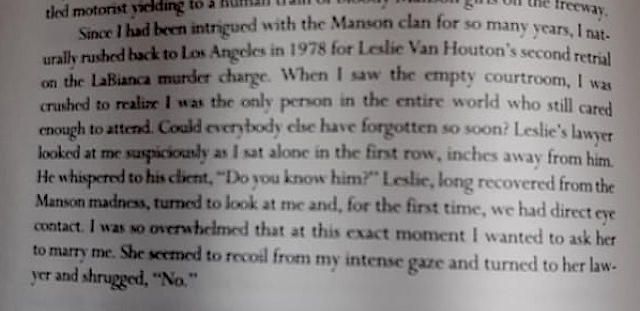
Bonus. When John and Leslie first locked eyes. 


Monday, October 28, 2019

The Labianca Murder House

Another Greg video. This time, the Labianca house on Waverly:


Monday, September 26, 2016

Approaching 3301 Waverly Drive

Recently I was reading the First Homicide Investigation Progress Reports for both the Cielo and Waverly Drives homicides and I got interested in the layouts of the crime scenes and what those layouts can tell us. 

I would take any opportunity to visit a location associated with a crime I am interested in, and all the more so to the precise locations where the crimes actually happened. But except for the place where Donald “Shorty” Shea was killed near Spahn’s Ranch in late August of 1969 I’ve never been to any of the pinpoint murder locations associated with TLB. (Of course, I’ve been outside all of the places.)

I first went up to the gate at Cielo Drive in 1978. Back then it was the same gate setup as was there on the night of the murders. You could look onto the property and see the corner of the garage. Sometime in the mid-’80s that puny security arrangement was replaced with something more substantial. 

In the early ’90s I was there again with some friends. One of them decided to see if we could get in, so he rang the buzzer. After a minute or so the gate (the big, new one) slowly opened and an attractive younger woman asked what we wanted. When my friend explained that I was a crime writer and wanted to see the property she was polite and friendly but turned down our entry request. 

Of course now there’s nothing to see on that property, its fate being well known. 

Aerial view of 10051 Cielo Drive in 1969

Google Maps view of the current Cielo property (Note the house on the hill to the left in both pictures.)

(I think that somebody should build an exact full-scale replica of the 1969 Cielo Drive property with everything — house, guest house, garage, pool, wishing well, lights on the fence — everything — so that students of the crime can go there and study it. Maybe in a cornfield in Iowa? Build it and they will come.)

The former LaBianca residence, on the other hand, is a different matter. The LaBianca property on Waverly Drive has likewise had a lot of work done to it, but the house, garage, and driveway areas remain largely unchanged. 

The LaBianca residence the morning after the murders there. The LaBianca’s boat is still on the trailer behind their car parked on the street to the west of the property. 

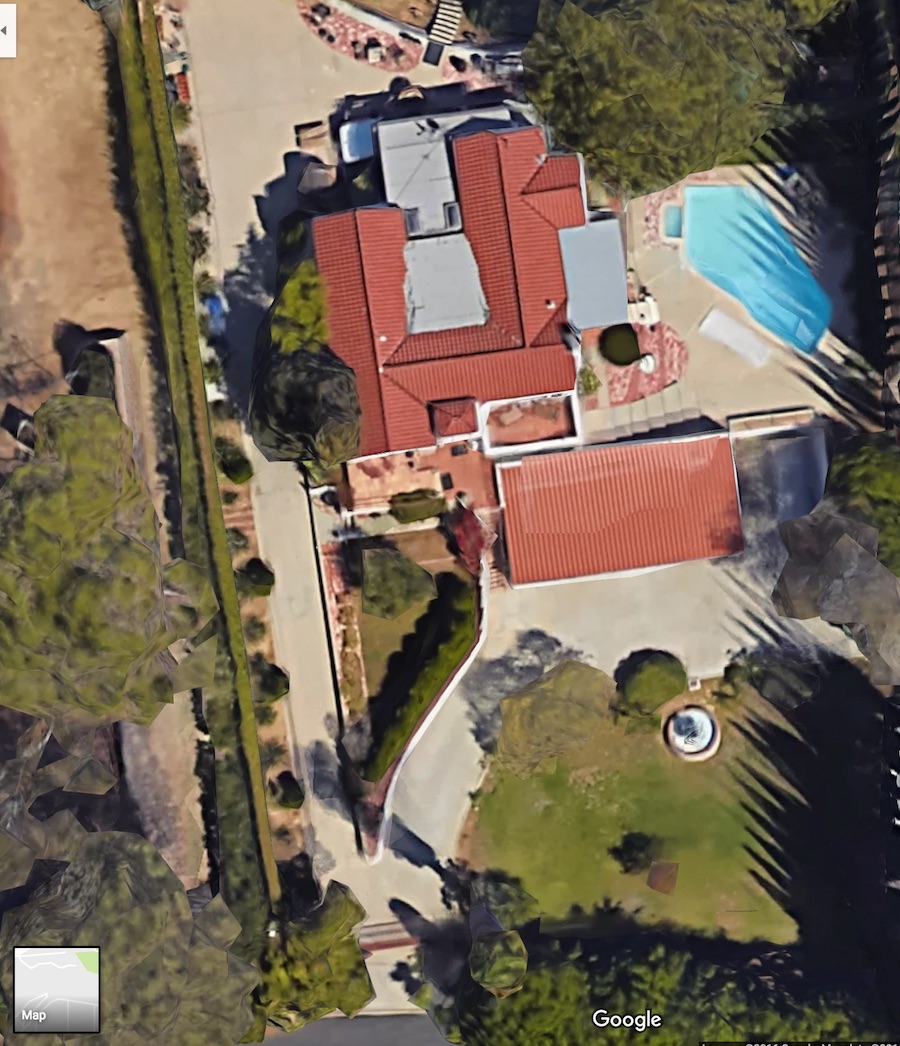
Google Maps view of the LaBianca house today

But a glance at these two above images makes it clear that much work has been done to the front and east side yards of the lot. In front a carport and additional driveway and parking area have been added. And to the east a swimming pool fills the area that used to be the side yard between the house and the property next door that was at one time occupied by Harold True.

There is general agreement regarding what happened immediately after the car from Spahn’s Ranch arrived at Waverly Drive late in the night of August 9-10, 1969: Charles Manson got out of the car and went up the curved driveway to Harold True’s house before cutting over west to the LaBianca house.This scenario is courtesy of star prosecution witness Linda Kasabian and is corroborated by Charles Manson himself. 

At the murder trial Kasabian recalled that after their car parked in front of the LaBianca house she asked Manson, “Charlie, you’re not going into that house, are you?”

“He said, ‘No, I’m going next door.’ 

“He got out of the car. He disappeared up the walkway, the driveway, leading towards Harold’s house, and I couldn’t follow him any longer, he just disappeared.”  (From Linda Kasabian’s trial testimony as recounted in Witness to Evil by George Bishop, page 165)

Manson agreed to this version of events in a telephone call to me in 1998:

“And I went to see Harold [True]. Harold wasn’t there, and I looked over and I seen a light over on the other side, and I walked over there and there was a little dog there. So I patted the dog on the head and I opened the door and there was a dude sitting on the couch. 

“And when I walked in, I said, ‘Oh, hey. Hi.’

“He said, ‘Hi.’

“I said, ‘I didn’t know anybody lived here.’ 

“He said, ‘Oh yeah, we moved in here last week,’ or something like that. ‘Da da da….’

“Tex was — he come in behind me. And me and guy got into a conversation, ‘Wah-wah-wah, roo-roo-roo,’ and I said, ‘Well, you know, I gotta go.’ 

“And then Tex moved in and started talking to him. And I walked on out.

“It didn’t have a fucking thing to do with me.”

Further along in her testimony Kasabian indirectly corroborates Manson’s version of what he did at the two Waverly Drive properties (i.e., check out Harold True’s house and then briefly enter and exit the LaBianca house before coming back to the car) when she was asked, “How long after he left the car did he return to the car?”

Kasabian answered, “I remember we all lit up cigarettes, and we smoked about three-quarters of a Pall Mall cigarette, however long that takes.” (Witness To Evil, page 165.)

That would probably take about five minutes, tops, just enough time for Manson to do what he said he did, but certainly not enough time for him to have done all the things that Charles "Tex" Watson later said he did inside the LaBianca house (got the drop on Leno LaBianca, reassured him, had Watson tie him up, asked about other people in the house, disappeared “for a minute or two” before bringing Rosemary LaBianca into the living room, conversed with the couple, waited with the couple while Watson looked around the house for money, took Rosemary LaBianca back into the bedroom, returned to the living room to bind, gag, and pillowcase Leno LaBianca, went back into the bedroom and did the same to Rosemary, and then finally left the house — See Will You Die For Me?, pages 147-148).

So, by examining a crime scene, even after almost fifty years, one can still gain new insights into what might have happened there. In this case, combining the evident walking distances involved and the time frame established by Linda Kasabian’s Pall Mall, a fair and reasonable person might come to the conclusion that Charles Manson was telling the truth about what he did after he arrived at Waverly Drive on August 9-10, 1969.

The LaBianca house from Helter Skelter

Closeup of side yards of the LaBianca and True houses, showing the side entrance area of the latter directly across the side yard from the east side of the LaBianca residence.

View of the LaBianca house from the east (True house) side

Diagram of the LaBianca house (courtesy of Cielodrive.com

This present day Google Maps view of the LaBianca and True residences shows that a small building has been constructed in the area that was formerly the western entrance to the True house. 


The former Polanski residence on Cielo Drive is long gone, but the LaBianca house and grounds have survived mostly intact. An examination of this latter property would no doubt prove very enlightening to any student of TLB. The MF Blog tried to gain access to the house as part of their 2016 tour but they were unable to do so. Maybe one solution would be to buy the house. Unfortunately, however, it’s not currently on the market. And in any case, it would take almost two million dollars to close the deal. 

Zillow listing for Waverly Drive house (The address was changed in an effort 
to detract from the notoriety of the house.)


I wonder what would be a better deal — buying the house or building an exact replica in Iowa?


Monday, December 7, 2015

The Guns of Helter Skelter

For two months in the summer of 1969 violence rode in the winds over Los Angeles, California. It started with the shooting of Bernard Crowe in a Hollywood apartment in the earliest days of July and ended with the stabbing death of Donald "Shorty" Shea near Spahn's Movie Ranch almost two months later. In between those two events eight other persons would lose their lives in a series of slayings that culminated in the infamous Tate-LaBianca or "Helter Skelter" murders on the nights of August 8-9. In its entirety the Tate-LaBianca case is one of the most complicated in the annals of crime. There were many different victims, killers, locations, dates, motives, methods of mayhem, and weapons involved, including many different kinds of guns. The recent MF Blog about Shorty Shea's guns made me think of all of the firearms connected with TLB, either directly or indirectly, and after some contemplation I came up with the following list. Herewith, then, in order of their chronological appearances that summer, is a catalog of the Guns of Helter Skelter.

The first gun in the series -- a .22 caliber nine-shot Hi Standard Ned Buntline revolver -- was the most important, because it was also the most widely used and deadly. In early July of 1969 Charles Manson shot the drug dealer Bernard Crowe with it in an act if self-defense while attempting to mollify Crowe after he was angered by being ripped off by Charles "Tex" Watson. That presumed fatal shooting set off the violent chain of events which eventually led to the murders on Cielo and Waverly Drives. The same revolver was used to lethal effect at the former address, where Watson used it to shoot and bludgeon three people to death. 

 The .22 caliber Hi Standard Buntline revolver used in the shooting of Bernard Crowe and the murders of Stephen Parent, Jay Sebring, and Voytek Frykowski (Photo courtesy of Cielodrive.com)


A nine-shot Hi Standard Buntline with the cylinder open

The origins of this particular firearm are murky. According to Vincent Bugliosi in Helter Skelter, "The gun, serial number 1902708, had been among a number of weapons taken from the Archery Headquarters in El Monte, California, during a burglary on the night of March 12, 1969. According to [Randy] Starr, he obtained it in trade with a man known only as "Ron." Manson was always borrowing the gun for target practice, and Randy finally gave it to him in trade for a truck that had belonged to Danny DeCarlo." (Manson implied in his 1986 interview with Charlie Rose that the "Ron" who was the source of this gun was then President Ronald Reagan.)

After the murders on Cielo Drive the gun was tossed out of the car window by the fleeing killers. It was found by a boy and turned in to the Los Angeles Police Department on September 1, 1969, but wasn't connected with the Tate murders until later, a cause of much subsequent  hand-wringing by Bugliosi over the Keystone Kops incompetence of LAPD.

In Helter Skelter Vincent Bugliosi used the search for the Buntline as another excuse 
to point out the incompetence of L.A. law enforcement.

If you want a Buntline today, this one should do.

The second firearm relevant to the sometimes savage summer of 1969 was used during an event which was sandwiched between the shooting of Bernard Crowe and the murders at the Polanski residence, namely the assault and murder of Gary Hinman at his home on Old Topanga Canyon Road on July 25-27, 1969. Although Hinman was beaten and stabbed to death, a firearm still figured in the overall occurrence. According to the January 27, 1970 police report of the incident: 

"On January 8, 1970, at the request of Sgt. Whitely, Homicide Bureau, Undersigned conducted an examination at 964 Old Topanga Canyon Road, Malibu, for bullets and bullet holes.

"What appears to be a bullet hole was observed in a wood upright portion of a cabinet under the sink in the kitchen. This piece of wood was removed for possible further examination.

"A bullet was recovered from the inside of the exterior wall immediately behind the sink. The bullet is 9 mm jacketed weighing approximately 126 grams and was fired in a weapon having six lands and grooves with a right twist and a land to groove ratio of approximately one to one.

"Bullets on file in this office with similar characteristics to the recovered bullet include those fired in Astra, Browning, Lugar [sic], Radon [sic], Star, and Walther semi-automatic pistols." (Thank you, Cielodrive.com!)

The gun used in that incident was in fact a 9 millimeter Radom automatic pistol loaned to Bobby Beausoleil by Bruce Davis to be used to help persuade Hinman to refund money due to Beausoleil as the result of a failed drug transaction. According to Danny DeCarlo, Davis purchased the gun at a gun store in Canoga Park about a month earlier.

A 9 mm Radom pistol

Radom automatics were military pistols designed and manufactured in Poland starting in 1935. After the German invasion of that country in the fall of 1939 Germany took over production of the weapon and continued to make them until the end of the war. Radom pistols have an excellent reputation and are regarded in firearms circles as one of the finest military sidearms ever made. If you want to buy one today you can, but it will cost you.

A current Internet ad for a Radom 

One gun I can't present here is the gun that was supposedly along on the night that Leno and Rosemary LaBianca were slain. Never accounted for before or since that night, the gun (according to Linda Kasabian during her trial testimony and Charles Watson in his book Will You Die For Me?) was wielded by Charles Manson during an aborted assault on the driver of a sports car on Sunset Boulevard. Manson also supposedly used this gun to cover the LaBiancas while Charles Watson tied them up (or, variously, while he tied them up himself). Linda Kasabian claimed to have seen the gun "on several occasions" that night but she was unable to give any kind of description of it, even as to whether it was a revolver or a pistol. One version of events says that this gun was buried on the beach by Steve Grogan. It has never been recovered.

But the guns that definitely were in the house at 3301 Waverly Drive that night were those belonging to Leno LaBianca himself. An apparent aficionado of the old west, LaBianca had an impressive collection of 19th century firearms that included several varieties of Colt-type Navy revolvers, a nickel plated 1858 model Smith & Wesson revolver, two Colt "Peacemaker" single-action revolvers, and a muzzle-loading dragoon pistol. Probably unnoticed by the killers, these classic guns were discovered in the house by police officers investigating the murders. Their value (and that of a coin collection and other valuables still in the house) was part of the reason that authorities were disinclined to believe that robbery was the motive for the killings.

Leno LaBianca's gun collection (courtesy of Cielodrive.com)

A replica of an 1851 Navy Colt revolver

Internet auction for a genuine Navy Colt

LIke Bruce Davis' Radom, the next gun in this series also arose out of the Second World War. During the raid on Spahn's Movie Ranch on August 16, 1969 authorities recovered the infamous "submachine gun in its violin case" pictured in the book Helter Skelter. This weapon a Maschinenpistole (MP)-40, was discovered during the raid along with several long guns in a room that has been described as a "gun room" but was actually just the room that Danny DeCarlo was temporarily residing in with his guns. 

An assortment of Danny DeCarlo's firearms found during the August 16, 1969 raid on Spahn's Ranch

Danny DeCarlo's MP-40 as presented in Helter Skelter

The same gun during the August 16, 1969 raid 

Sometimes incorrectly referred to as a Schmeisser, the Maschinenpistole (MP)-40 was a workhorse of the German Wehrmacht during World War Two. After the war stockpiles of the weapons were distributed into the international gun world by the victorious Allies and some examples continued to be used in combat situations as late as the Vietnam War.

A beautiful example of a Maschinenpistole-40 submachine gun

If you thought the Radom was expensive, then don't even think about acquiring an MP-40. Even if you could get a license to own one the cost of buying a genuine wartime example is astronomical. 

Check out the price on this offering!

The next guns to be connected in sequence to the events of the summer of 1969 were the matching set of .45 caliber pistols belonging to Donald "Shorty" Shea, the complete story of which you can read here.

Shorty Shea's guns 

Guns figured in the immediate aftermath of the Hinman-Tate-LaBianca-Shea murders as well, most notably when they were used to propaganda effect in the 1973 Robert Hendrickson/Laurence Merrick documentary Manson. That film features several segments where Nancy Pittman, Lynette Fromme, and Sandra Good handle an assortment of long guns. And there is also a famous still photograph from the film of Steve Grogan holding a large caliber revolver of unknown manufacture.


Nancy, Lyn, and Sandy with shotgun and rifles

Steve Grogan and revolver

Other weapons later associated with persons and events connected to the so-called "Manson Family" include the .22 caliber Iver & Johnson revolver with which John Philip "Zero" Haught either intentionally or accidentally killed himself in Venice, California on November 5, 1969, and those used in the shootout at the Hawthorne Western Surplus store on August 21, 1971 (over one hundred firearms were ultimately involved in that incident!). But both of those events were separate incidents that occurred after the murderous Helter Skelter summer of 1969, and they did not directly reflect on the Tate-LaBianca murders and the acts of violence related to them (Crowe, HInman, and Shea) as did the girls' propagandistic posturing in Manson, and therefore they are beyond the scope of this post.


Thursday, October 22, 2015

Losing Sight Of Victims' Families

From past postings I have done, you can probably come to the conclusion that I am not a "fan" of Manson, Tex, Susan, Pat and the others. I am also not one who thinks of conspiracies when analyzing this tragic, horrendous case either. It doesn't matter what I or anyone else thinks anyway. Nothing we write on here is going to bring back any of the victims or make anyone feel better. With that being said, I think, over the years, as people continue to discuss, analyze & debate different aspects of this case, we have lost sight of the fact that the Manson Family killers/helpers/perpetrators (whatever you want to call them) not only stole the lives of the victims, but they completely devastated & ruined the families that were left behind. How did the families function when they had to plan funerals, clean & sort through their loved ones belongings, deal with estate/inheritance issues, lawsuits, and financial losses, including IRS bullshit all the while knowing their murdered loved one suffered in the most brutal of ways? The LaBianca family, for example, went through so much unnecessary estate problems, because of all the debts & issues with Leno's financial problems. Not to mention the greed that came out of the woodwork too! What about the Tate family? They had been extremely excited about the upcoming birth of the new baby and had been planning accordingly,  but instead had to endure a VERY PUBLIC funeral in place of welcoming a new member of their family. These are just two examples of what some of the families went through. It would take a whole book to mention all the others. The heartbreak & loss was unimaginable, I am sure. On top of the severe depression & devastating loss, these people had no privacy to mourn in peace. Their loved ones were not only butchered, but then they were BLAMED for their own deaths. This is the stuff of nightmares. These people really, truly lived it and I, for one do not know how they survived. We've all probably seen this show, but watch how Patti Tate explained to Maury Povich how horrible it was the morning they found out about Sharon's murder:


Now that the 46 year anniversary of these horrible crimes has happened, I would like to just let our readers know that I hope we can continue respectful discussions over this case without losing sight of the victims and the victims' families that were left behind. We will not ever forget what this is about, which is the incredible, brutal loss of MANY lives......

Frank Struthers Jr-Rosemary LaBianca's son

 Suzan Struthers-Rosemary LaBianca's daughter

Jay Sebring's sister

Steven Parent's mother & father + sister

Abigail Folger's brother & sister

Wojiciech Frykowski family

Tate Family & Roman Polanski

Shorty Shea's wife

Kay Hinman Martley-Gary Hinman's cousin


Monday, January 6, 2014

The Missing Link, Part Penultimate

Parts 1, 2 and 3 of this series can be found here, here and here.

Blogger Cybot asked, "did drug trade start by hippies and then go to the organized crime, or were drugs traded by o. c./mafia from the beginning? - and when did the trade start?" Patty was thinking about his questions the other night while watching the Ken Burns documentary on prohibition. Was that when organized crime started in the US? Of course not.

From the very minute folks got off the Mayflower, they started forming alliances just like they do on Survivor. Even before that, the natives likely did the same. Those who are the most organized, have the most resources, make the best alliances, always win. Those who overstep the boundaries created by the dominant group are marginalized and punished. When one season is over, another rises to take its place. This is the way the world has worked since the very beginning.

We are interested in a very short capsule of time when studying the murders, which might be described as the proverbial "perfect storm." We know that up north, the Brotherhood of Eternal Love (BEL) had deals with the Panthers, with the Gypsy Jokers and also with the Angels (see here). To the south, the mob had been in Hollywood for quite some time, but were not really involved in the trade of psychedelics. If anything, they were supplying cocaine, but not on the scale that they later would. In the summer of 69, there was a market for psychedelics, and there were many competing parties who wished to be the fulfillment arm of the BEL drug empire.

The BEL began as a group of high school students in Anaheim. You will remember that John Griggs, founder of the BEL, hadn't tried LSD until he and his friends dropped acid near Palm Springs. Griggs relieved a "famous producer" of his cache of Sandoz LSD during a Hollywood Hills dinner party in 1966. That experience was the birth of his organization, which he preferred to call a church rather than an organized crime syndicate.

By all reports, Griggs was well intentioned about using LSD to the betterment of humanity. The BEL lobbied to become an official, tax-free religious organization: when it was accomplished, he named California Governor Ronald Reagan as an honorary member!

Anyway, Patty digresses. The point of all off this is that the identity of the producer who had a kick ass, laboratory grade connection and who did not prosecute Griggs may be relevant. Who and what the famous producer actually produced is unknown. Patty has compiled a short list of guesses, as follows:

Bob Evans was very close friends with Roman and Sharon and had produced Rosemary's Baby.  He hosted a large, lavish funeral reception for Sharon. Bob was an infamous partier who, with his brother Charles, was convicted of cocaine trafficking in 1980.

Clive Davis was general manager of Columbia Records by 1965. He is responsible for signing Janis Joplin after the Monterrey Pop Festival of 1967, and for bringing the Grateful Dead to the Arista Label in the 70's. Bob Weir would occasionally change the lyrics of Jack Straw in concert from "we used to play for silver, now we play for life," to "we used to play for silver, now we play for Clive."

Terry Melcher and Bruce Johnston formed the vocal duet Bruce & Terry in the early '60s. Later, Johnston joined The Beach Boys and Melcher went to work with the Byrds for Columbia Records. There, he produced  "Mr. Tambourine Man" and "Turn! Turn! Turn!" Melcher also performed on Pet Sounds as a background vocalist and was a producer of the Monterrey Pop Festival in 1967.

Chuck Barris, of all people, is a weirdly compelling shortlister. Wait a sec, hear Patty out before you start L'ing YAO. Chuck Barris married Lyn Levy, whose father founded CBS, in 1957. He first became uber-successful during 1965 with his creation of The Dating Game on ABC. He also produced the Canadian-based Bobby Vinton variety show and infamously claims to have worked for the CIA.
Brian Wilson would be the most expeditious and direct choice for the "famous producer" in question. The Beach Boys were signed to Capitol Records in 1962. They released their groundbreaking single "Good Vibrations" and album Pet Sounds in 1966. According to many sources, brother Dennis was a hub around which many relevant relationships centered. The Neil Young connection is said to have been through Dennis. Bryan Lukashevsky knew Dennis, too. Strangely, Lukashevsky (who now lives in Honolulu) told Brian Davis in March, 2012 that one day soon, the time will be right for the real story to come out. He did not elaborate on why that is. 

Is it safe to say now that everybody absolutely did know everybody else on the scene in 1969? How to the LaBiancas fit in to all of this?

According to police investigation reports, Leno was part-owner of nine thoroughbred horses. He liked to make large bets at the track, frequented Las Vegas as late as March, 1969 and had misappropriated about $200,000 from his Gateway Markets since 1964. When he met and married Rosemary, she was a waitress at the Los Feliz Inn. At the time of her death, she had two dress shops: one having just been opened on Figueroa Street in LA. This is not a nice area. In fact, it is within yards of noisy Interstate 5 which runs from Mexico, where Rosemary was born, all the way to Canada.

Leno was a board member at the Hollywood National Bank. It is long gone, but it used to sit a block south of Hollywood and Vine at Argyle. Today, this is next to the Pantages Theater and within view of the Capitol Records Building (see left). According to an article at TOTLB, Hollywood National opened to much applomb in 1964 with appearances by celebrities and government officials. Wouldn't you just love to know which ones? Patty sure would. She would also love to see Hollywood National's books, or at least a copy of the local and federal investigations into them. By 1967, Leno's colleagues were being investigated and convicted for laundering "hoodlum money." By 1971, the bank was bought out by United States National Bank of Portland; by 1973, it became a part of Wells Fargo.

The BEL's ability to produce Orange Sunshine was financed by Billy Hitchcock, a richie rich from the East Coast who rented Millbrook in 1963 so that Tim Leary, et. al. could perform their "research" there in peace. He was a member of the Carnegie Mellon family on his mother's side: "old money" they call it, with ties to huge companies like Gulf Oil, Alcoa, New York Shipbuilding, Westinghouse, Newsweek, U.S. Steel and General Motors.

He had large deposits at The Castle Bank & Trust, an infamous Bahamanian bank founded in the 1960s by a former member of the US Office of Strategic Services and a tax lawyer friend. In 1967, the bank's clients were celebrities, organized crime figures and wealthy business owners like Hitchcock, Credence Clearwater Revival, Tony Curtis, Hugh Hefner, the Pritzker family (Hyatt Hotels), and Las Vegas gangster Moe Dalitz.The Mary Carter Paint Company, one of the the bank's shell companies, later became Resorts International which built a luxury hotel in the Bahamas called Paradise Island. President Richard Nixon stayed there on many occasions. Castle Bank contributed quite a bit of money to his re-election campaign, as discovered by the Ervin Committee in 1972.

In 1968, Hitchcock purchased land just north of one of his homes in Sausalito, then put Nick Sand and Tim Scully on retainer. Shortly thereafter, Hitchcock and Owsley hired a New York law firm called Rabinowitz, Boudin and Standard to look into the possibility of legally producing LSD and hash in the Bahamas. Soon thereafter, the IRS' "Operation Tradewinds" revealed that Castle Bank was involved in tax evasion. It was also covertly funneling funds for CIA military operations including the anti-Castro maneuvers at Andros Island.

By this time many investors including Billy Hitchcock had moved their funds elsewhere. The IRS planned to initiate a new investigation called Project Haven into the affairs of individual Castle Bank clients like Billy's college chum, Sam Clapp. However, according to the Wall Street Journal, the investigation was dropped because of "pressure from the CIA." Castle Bank collapsed in 1977 leaving poor John Fogerty and many others in the lurch. You can draw your own conclusions about that. In any case, Patty would love to find a connection between Hollywood National and The Castle Bank or any of its shell companies, and she is still looking into it.

Phew...that was a lot. Are you still with Patty? Let's sit on that for a while. She promises the next post will be the last in this series.  Happy New Year, and PEACE.