 |
| The Roommates |
After driving all over the city of Los Angeles on the night of August 9, 1969, Charles Manson settled on Waverly Drive for a second night of Helter Skelter murders. Manson, after parking the car where the car is located in the picture, below right, headed up the True House driveway, alone (to the right in the photograph). At some point he cut across the lawn to the LaBianca house where the murders were committed.
Some commentators suggest the ‘real’ targets that night were Harold True’s roommates (Swerdloff, Baltzell and Yost) According to this version of events, the three had refused to allow Manson to move into the home in the fall of 1968 and this so infuriated Manson that when the chance arrived, he sought revenge.
These commentators conclude that Manson, finding the True House empty, only then moved on to house number two. However, for a number of reasons, this theory doesn't seem to me to be supported by the available evidence.
[Aside: Harold True is the primary witness for most of what we know about 3267 Waverly Drive. That's why we call it the True House. However, he is not very reliable when it come to dates. They change from time to time and he gets several of them wrong. For example at the Tate-LaBianca trial he was 'positive' he met Charles Manson in March of 1967 at Phil Kaufman's home in Topanga Canyon. Kaufman was in jail for another year.]
These commentators conclude that Manson, finding the True House empty, only then moved on to house number two. However, for a number of reasons, this theory doesn't seem to me to be supported by the available evidence.
[Aside: Harold True is the primary witness for most of what we know about 3267 Waverly Drive. That's why we call it the True House. However, he is not very reliable when it come to dates. They change from time to time and he gets several of them wrong. For example at the Tate-LaBianca trial he was 'positive' he met Charles Manson in March of 1967 at Phil Kaufman's home in Topanga Canyon. Kaufman was in jail for another year.]
I would like to thank Deb for doing the initial research for this post and also for inspiring me to do the rest.

3267 Waverly Drive
Here is how Harold True described the house at one time.
_____
“Our house on Waverly was like Frankenstein’s castle with a strobe light going all the time in the dining room. Such a variety of strange things went on at the house. We all thought that the police knew about us. One time I was going down Sunset Boulevard and picked up a hitchhiker. He told me, “Hey, there’s a great party. Here’s a map.” I said, “I think I can find it. It’s to my own house!” The guy was telling me about my own party. So you figure somewhere on the streets, somebody’s got to get this stuff.”
 |
| The True House Cielodrive.com |
(Harold True quoted in Kaufman,Phil. Road Mangler Deluxe (Kindle Locations 3972-3976). White-Boucke Publishing. Kindle Edition)
_____
The house, pictured in the photograph above and in that photograph to the upper right, consisted of a main house, rented by Harold True and his friends, a garage and a guest house. The guest house was occupied by Julia Posella. The home was owned jointly, according to deed records, by Julia Posella and Seglinda Joya Posella Bergstrom, her daughter.
The Roommate Revenge Motive
If we assume Helter Skelter was, indeed, the motive that night (I’m not convinced) then, it seems to me, the targets of the attack should be ‘sacrificial lambs’ chosen to further the cause of Helter Skelter. If we assume Manson isn’t stupid I think we also have to assume he wouldn’t murder someone who could easily link Manson directly to the murders. It also seems to me that the event that eventually triggers revenge also has to have been significant. Manson had to be pissed like he was after the Esalen snub and the Terry Melcher snub. Finally, for this motive to work at all the house has to be vacant that night.
The Roommates: A Full House- Two Pair with a Wild Card
The First Pair: Buddy Baltzell and Harry Yost
Ernest (Ernie) “Buddy or Bud” Vern Baltzell
 It is likely Baltzell actually was the primary tenant of 3267 Waverly Drive, not Harold True. Baltzell’s name appears in the 1968 phone directory as being the resident of 3267 Waverly Drive.
Buddy was born in 1940. He attended Hollywood High School where he played football. Upon graduation he joined the United States Army and served in the 101stAirborne.
According to his memorial page (he passed away in 2007) Baltzell worked as a lithographer for 30 years. His hobbies included skiing, fishing trips, bungee jumping in New Zealand, and ‘hosting the famous West Covina Labor Day Party’.
According to his memorial page (he passed away in 2007) Baltzell worked as a lithographer for 30 years. His hobbies included skiing, fishing trips, bungee jumping in New Zealand, and ‘hosting the famous West Covina Labor Day Party’.
 |
| Buddy 1957 |
My belief this picture is from 3267 Waverly is based upon the fact that after the group separated in September 1968 they never got back together as a ‘foursome’. Specifically, I have found no indication that True ever linked back up to Baltzell and Yost and True and Baltzell are in the image.
I think it was probable that Baltzell and Yost distanced themselves from the whole Waverly Drive scenario very quickly after the murders and their connection came to light. I found it odd that I was unable to find any indication that any of the Roommates except Harold True were ever interviewed by LAPD. I assume that they were but none testified to my knowledge and none are mentioned in the tomes, except by True.
Harry Yost
Unfortunately, I was unable to find much information about Harry Yost.
He attended Hollywood High School with Baltzell. He also played football with Baltzell as he
appears in this picture of the football team with Baltzell (whose name is misspelled as ‘Batzell’). Unfortunately, they decided in 1957 to simply alphabetize the names of the players and not indicate who is who in the picture.
appears in this picture of the football team with Baltzell (whose name is misspelled as ‘Batzell’). Unfortunately, they decided in 1957 to simply alphabetize the names of the players and not indicate who is who in the picture.
 Yost also receives a brief mention on Bud Baltzell’s memorial page in a letter posted there by a friend, discussing a few memories.
“Harry Yost and the Hawaiian princess, towing a car in Mexico only to lose control and have the towed car pass them and crash, pranks big and small and all done in a good natured, ultimately harmless way.”
Who is Yost in the Waverly image, above?
I believe he is the individual on the right because that person also seems to be in the middle of this picture (left) from 1962, which includes both Ernie Baltzell and Harold True.
 |
| Baltzell, True, Yost?, ? 1962 |
Baltzell and Yost graduated from Hollywood High School in 1958. Baltzell's memorial page says he graduated in 1957 but he is not listed in that yearbook as a senior. Unfortunately, the 1958 yearbook for Hollywood High School is not available on line.
Eleven years later Yost and Baltzell would cross paths with another Hollywood High graduate: Vincent Bugliosi, class of 1952.
The Second Pair: Harold True and Allan Swerdloff
Like Baltzell and Yost, True and Swerdloff attended high school together at Birmingham High School
in Van Nuys, California.
Harold True
in Van Nuys, California.
Harold True

 Harold True played football in high school and, based upon his graduation picture attended Los Angeles Valley College after graduation. During the time he resided on Waverly Drive True was a graduate student at UCLA. His major was medieval history. I don't believe he ever obtained his PHD. I found no record of it. In Phil Kaufman's autobiography, Road Mangler Deluxe, True is described like this:
 "Harold True is a victim of the ’60s. His experiences with an ongoing battle to fight drug addiction have left him weak, rambling and somewhat bitter."
(Kaufman,Phil. Road Mangler Deluxe (Kindle Locations 3933-3934). White-Boucke Publishing. Kindle Edition.)
_____
Here is how True described himself at Waverly Drive.
_____
 "Around the time I lived on Waverly Drive, I attended college Monday to Thursday. On the weekend, I’d just go crazy. At the time, I was taking huge amounts of amphetamines. I went to a psychiatrist and told him, “I got a problem. I’m taking amphetamines for college.” He said, “Everyone does that. What do you take, four or five a day? Is your habit that far?” I said, “No. My habit right now is I set my alarm clock for 4:30 a.m., it goes off, I get a glass of water, take 15 Dexedrines and go back to sleep. An hour later, I wake up bright-eyed and bushy-tailed, shit, shower and shave, and go to school. Then in class, I take 10 or 15 more. When I finish at school, I take another 10 or 15.”
(Harold True quoted in Kaufman,Phil. Road Mangler Deluxe (Kindle Locations 3954-3960). White-Boucke Publishing. Kindle Edition.)
_____
And here is some of the bitterness.
_____
"I had to go testify at those goddamned trials. And every time I testified, guess whose name got in the papers? I lost a job as a school teacher because of it. One time we noticed that an unusual amount of traffic was passing by our house, and when they came by, they all had their noses up at the window looking at us like we were freaks. To know Charles Manson, you had to be a freak also."
(Harold True quoted in Kaufman,Phil. Road Mangler Deluxe (Kindle Locations 3980-3983). White-Boucke Publishing. Kindle Edition.)
_____
True graduated in 1958 and went off to LAVC. Another Manson-related character also attended Los Angeles Valley College a couple years after True: David Gerrold (Jerrold D. Friedman) the man Steven Parent called from Cielo Drive.
Allan Swerdloff
 |
After graduation Swerdloff joined the air force with a class mate named Lawrence “Sonny” Diaz. He served one tour of duty and was a medic stationed in the Philippines.
 |
| Van Nuys News July 3, 1958 |
After all this passed into history Swerdloff formed several businesses, the most recent is named Swerdloff Designs.
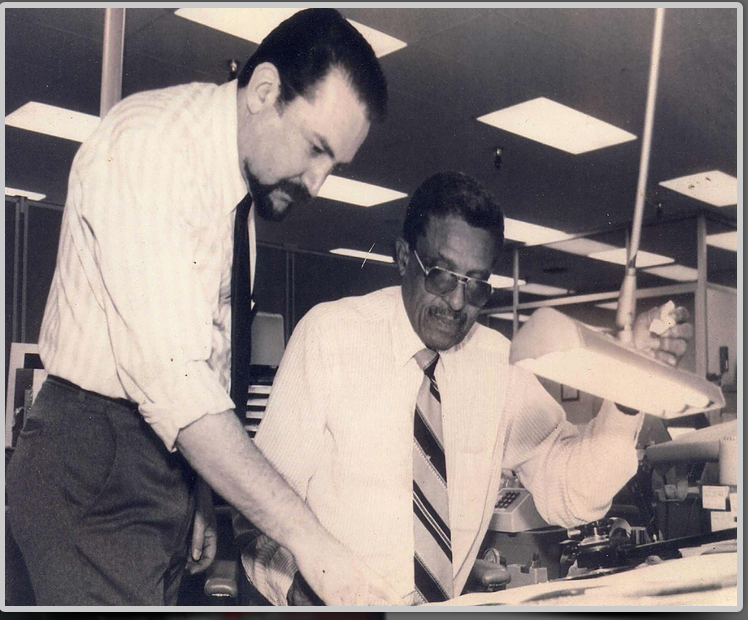 |
| Allan Swerdloff date unknown |
Baltzell and Swerdloff each served at least one tour of duty after graduation. In 1958, from what I could find, that would have been either two years (with reserve obligations) or three years and done. That means the ‘roommates’ all would have been ‘available’ to meet by say 1961-62, which fits well with the 1962 photo, above.
The Wild Card: Phil Kaufman
 Without Phil Kaufman there is no connection between Charles Manson and 3267 Waverly Drive. The Roommates likely never meet him.
Most of what we know about Kaufman’s connection to Manson is summed up (yes, there are interviews, too) in his ‘autobiography’ Road Mangler Deluxe. The person who put Colin White (the 'author') in contact with the Kaufman at the outset was Allan Swerdloff.
"I first came into contact with Phil Kaufman through a mutual friend, Allan Swerdloff. Allan had recommended Phil many times during our lengthy discussions on various facets of the California lifestyle which I was researching for another work—"Califobia: adventures in lala land"—and had suggested that Phil may even be a good subject for a book."
(Colin White in Kaufman,Phil. Road Mangler Deluxe (Kindle Locations 123-125). White-Boucke Publishing. Kindle Edition)
"I first came into contact with Phil Kaufman through a mutual friend, Allan Swerdloff. Allan had recommended Phil many times during our lengthy discussions on various facets of the California lifestyle which I was researching for another work—"Califobia: adventures in lala land"—and had suggested that Phil may even be a good subject for a book."
(Colin White in Kaufman,Phil. Road Mangler Deluxe (Kindle Locations 123-125). White-Boucke Publishing. Kindle Edition)
“Special thanks to Allan Swerdloff for his valuable help, patience and friendship through the years and for turning me on to my publisher.”
(Kaufman,Phil. Road Mangler Deluxe (Kindle Locations 62-63). White-Boucke Publishing. Kindle Edition.)
Kaufman’s connection to the story starts in about 1962. By then Kaufman knew the Roommates or at least some of them. Kaufman was arrested for trying to smuggle pot into the country from Mexico. He was facing 5-20 years if convicted. He jumped bail ($5,000 put up by his mother) and fled the country. He traveled about Europe and was finally apprehended in Sweden. The whole time he was on the lamb he travelled with a passport obtained using Harold True’s birth certificate. Eventually, he found himself at Terminal Island and in 1967 he met Charles Manson.
According to Kaufman when he was released from prison the wife of a fellow inmate drove him to the home of Al Swerdloff in Los Angeles.
_____
"When I walked out of Terminal Island prison in 1968, the wife of one of the inmates took me to the L.A. home of Allan Swerdloff, whom I had known before this whole thing had happened. They had arranged a getting-out party for me. A black girl called Janet opened the door, looked at me and said, “Hey, there’s a cop out there.” My homecoming party from prison, and they thought I was a cop!"
(Kaufman,Phil. Road Mangler Deluxe (Kindle Locations 744-747). White-Boucke Publishing. Kindle Edition.)
_____
If accurate (much of what Kaufman says is not accurate) that house would have been 3267 Waverly Drive, the True House.
Later, Kaufman drifted to Topanga Canyon and hung around there with the Family for awhile. Harold True claims he met Manson when he went to visit Kaufman at a 'dilapidated house' in Topanga Canyon (the Spiral Staircase?) where Kaufman was staying. The next day True helped Manson move to a 'house in Hollywood' and Manson and 'the girls' spent the night a t3267 Waverly Drive.
According to Kaufman when he was released from prison the wife of a fellow inmate drove him to the home of Al Swerdloff in Los Angeles.
_____
"When I walked out of Terminal Island prison in 1968, the wife of one of the inmates took me to the L.A. home of Allan Swerdloff, whom I had known before this whole thing had happened. They had arranged a getting-out party for me. A black girl called Janet opened the door, looked at me and said, “Hey, there’s a cop out there.” My homecoming party from prison, and they thought I was a cop!"
(Kaufman,Phil. Road Mangler Deluxe (Kindle Locations 744-747). White-Boucke Publishing. Kindle Edition.)
_____
If accurate (much of what Kaufman says is not accurate) that house would have been 3267 Waverly Drive, the True House.
Later, Kaufman drifted to Topanga Canyon and hung around there with the Family for awhile. Harold True claims he met Manson when he went to visit Kaufman at a 'dilapidated house' in Topanga Canyon (the Spiral Staircase?) where Kaufman was staying. The next day True helped Manson move to a 'house in Hollywood' and Manson and 'the girls' spent the night a t3267 Waverly Drive.
How Did The Roomates Meet?
The two pairs, above, obviously met in high school. I was not able to discover how the four got together but by 1962, from the photograph above, at least Baltzell and True had become friends. True claims he met Kaufman, originally, while he was at UCLA in the early sixties.
_____
"Phil was peripheral to the UCLA scene, but I knew him. We helped each other out when we could."
(Harold True quoted in Kaufman,Phil. Road Mangler Deluxe (Kindle Locations 3941-3942). White-Boucke Publishing. Kindle Edition)
_____
While that could be true the problem is, in the same passage, True also says he was at UCLA in the late 60's and we know he knew Kaufman in the early sixties. I the late fifties and maybe the early sixties True was at Los Angeles Valley College. If he spent two years there (it is a Junior College) and entered UCLA after he spent almost eight years as a graduate student at UCLA [Bluto: Christ! Seven years of college down the drain. I might as well join the f--king Peace Corps.]
I think Kaufman may possibly answer part of the question how they met, at least as to Harold True, without actually answering it in Road Mangler Deluxe. True and Kaufman may have been fraternity brothers.
_____
"Phil was peripheral to the UCLA scene, but I knew him. We helped each other out when we could."
(Harold True quoted in Kaufman,Phil. Road Mangler Deluxe (Kindle Locations 3941-3942). White-Boucke Publishing. Kindle Edition)
_____
While that could be true the problem is, in the same passage, True also says he was at UCLA in the late 60's and we know he knew Kaufman in the early sixties. I the late fifties and maybe the early sixties True was at Los Angeles Valley College. If he spent two years there (it is a Junior College) and entered UCLA after he spent almost eight years as a graduate student at UCLA [Bluto: Christ! Seven years of college down the drain. I might as well join the f--king Peace Corps.]
I think Kaufman may possibly answer part of the question how they met, at least as to Harold True, without actually answering it in Road Mangler Deluxe. True and Kaufman may have been fraternity brothers.
_____
“I was a student at Los Angeles Valley College on the GI Bill. I joined a fraternity which was full of ex-GIs. We drank too much, if there’s any such thing. (I’ve always said there’s no such thing as “too much.”)”
(Kaufman,Phil. Road Mangler Deluxe (Kindle Locations 333-335). White-Boucke Publishing. Kindle Edition.)
_____
Kaufman does not say when he was at LAVC. He does say after serving in the Korean War he returned to Los Angeles in 1957, one year before True graduated from High School.
The explanation makes sense, watch Animal House or a few Rob Lowe scenes from St. Elmo’s Fire. In a fraternity the ‘old’ guys’ were legend. I know because I was one. Their stories survived from class to class with new initiates learning the fables about the older guys. When the older guys graduated for a few years if they returned the young guys would gather around a keg to hear the stories. When you graduated, if you were in the same locale, you continued the lifestyle with your 'brothers' until jobs, women or worse separated you. There is a bond between 'brothers' that at a younger age I likely would never have broken. If you needed my help I was there. You would do anything for a brother, especially if he came bearing dope, women or beer. Kaufman would be like 'Billy Hicks' in St Elmos Fire to the younger guys.
The explanation makes sense, watch Animal House or a few Rob Lowe scenes from St. Elmo’s Fire. In a fraternity the ‘old’ guys’ were legend. I know because I was one. Their stories survived from class to class with new initiates learning the fables about the older guys. When the older guys graduated for a few years if they returned the young guys would gather around a keg to hear the stories. When you graduated, if you were in the same locale, you continued the lifestyle with your 'brothers' until jobs, women or worse separated you. There is a bond between 'brothers' that at a younger age I likely would never have broken. If you needed my help I was there. You would do anything for a brother, especially if he came bearing dope, women or beer. Kaufman would be like 'Billy Hicks' in St Elmos Fire to the younger guys.
The second reason I think this might be right is because the pictures ‘feel’ like a fraternity: booze, women, pranks, practical jokes and a few drugs. At least mine was like that almost twenty years later.
On the flip side I found no evidence Yost or Baltzell attended LAVC or any sort of college and Swerdloff attended a trade school.
Again, think Animal House. From the quotes above we know acid, speed, pot and booze were ever-present at 3267 Waverly Drive. Kasabian partied there one time in the summer of '68. She and her husband, and according to True, a couple other guys got in because True knew someone who knew someone in her crew. Manson spent the night with 'the girls' one time and several other times he dropped by with 'some guy' who picked him up hitchhiking.
In his taped interview with Aaron Stovitz True described Waverly as a 'party house'. There was a constant presence of partiers. If you knew someone who knew someone you could get in.
_____
Q (Keith): And there was Linda?
 A (True): Yes. It was the time of the communes.
Q: Did I hear you say it was the era of the commune?
A: Yeah. A lot of communes in the 60's. If you knew one of the people in the communes, you wound up knowing a lot of people.
(Harold True testimony 1977 trial of Leslie Van Houten)
_____
The picture to the right is Ernie Baltzell. It was not taken at Waverly. Look in the background. The pictures of the Beatles from the 'White Album' are on the wall. That means the photo is from sometime after November 1968.
Life at 3267 Waverly Drive
Again, think Animal House. From the quotes above we know acid, speed, pot and booze were ever-present at 3267 Waverly Drive. Kasabian partied there one time in the summer of '68. She and her husband, and according to True, a couple other guys got in because True knew someone who knew someone in her crew. Manson spent the night with 'the girls' one time and several other times he dropped by with 'some guy' who picked him up hitchhiking.
In his taped interview with Aaron Stovitz True described Waverly as a 'party house'. There was a constant presence of partiers. If you knew someone who knew someone you could get in.
_____
Q (Keith): And there was Linda?
 A (True): Yes. It was the time of the communes.
Q: Did I hear you say it was the era of the commune?
A: Yeah. A lot of communes in the 60's. If you knew one of the people in the communes, you wound up knowing a lot of people.
(Harold True testimony 1977 trial of Leslie Van Houten)
_____
The picture to the right is Ernie Baltzell. It was not taken at Waverly. Look in the background. The pictures of the Beatles from the 'White Album' are on the wall. That means the photo is from sometime after November 1968.
Now, Back to Your Original Programming
Does the Roommate Revenge motive stand up to the evidence? No, it does not.
Did the Roommates Snub Manson?
A key underpinning of the Roommate Revenge motive requires the roommates to actually disrespect Manson by refusing to allow Manson to join them at 3267 Waverly. This event has to be significant enough that Manson harbored a grudge for about a year worthy of murder.
True in his interview with Aaron Stovitz says the Roommates refused to allow Manson to move in. However, he also said this:
_____
"Charlie wanted to come and live with us on Waverly Drive. He stayed for about a week, ten days, but then we said no."
(Harold True quoted in Kaufman,Phil. Road Mangler Deluxe (Kindle Locations 3963-3964). White-Boucke Publishing. Kindle Edition.)
_____
Of course this contradicts his trial testimony where he consistently said Manson spent only one or two nights on two separate occasions at Waverly. It also contradicts what True told Stovitz.
But why would Manson carry a significant grudge over this incident? While True testified at Leslie Van Houten’s trial that the house was rented on a month to month tenancy there is something about the stay there running from September 1967 to September 1968 that sounds like a one, year lease to me.
According to True when he was leaving in September 1968 Manson asked him if he could stay at Waverly and True told him to ask the roommates, who said 'no'.
According to one version of True’s testimony the other three left in October, 1967.
_____
_____
"Charlie wanted to come and live with us on Waverly Drive. He stayed for about a week, ten days, but then we said no."
(Harold True quoted in Kaufman,Phil. Road Mangler Deluxe (Kindle Locations 3963-3964). White-Boucke Publishing. Kindle Edition.)
_____
Of course this contradicts his trial testimony where he consistently said Manson spent only one or two nights on two separate occasions at Waverly. It also contradicts what True told Stovitz.
But why would Manson carry a significant grudge over this incident? While True testified at Leslie Van Houten’s trial that the house was rented on a month to month tenancy there is something about the stay there running from September 1967 to September 1968 that sounds like a one, year lease to me.
According to True when he was leaving in September 1968 Manson asked him if he could stay at Waverly and True told him to ask the roommates, who said 'no'.
According to one version of True’s testimony the other three left in October, 1967.
_____
Q (Bugliosi): These gentlemen you were living with, these three other gentlemen, when you moved out of the Waverly address ln September of 68 were they still living there?
A. Yes.
Q: Did they eventually move out?
A: Yes.
Q: Do you know When?
A: October, November of ‘68, right after I did, they stayed about a month.
A: October, November of ‘68, right after I did, they stayed about a month.
(Cielodrive.com, Testimony of Harold True at Tate-LaBianca)
_____
In another version, they left at the same time as True.
_____
Q (Kay): When you moved out in September of ’68 did your other three roommates move out also?
A: Yes.
(Cielodrive.com, Testimony of Harold True at the 1977 trial of Leslie Van Houten)
_____
We know Baltzell, Yost and Swerdloff all left within a month of True or at the same time. So any conversation probably went like this: ‘Sorry, Charlie, but we are all leaving’. This is hardly a rejection worthy of homicide. No one was going to stay there after September, not just Manson.
Another problem is that I have not been able to find any reference to Manson actually carrying a grudge over this or being angry about it. If the snub was a big deal wouldn’t Harold True remember the reaction? While he mentions the incident in his interview in January 1970 with Aaron Stovitz he mentions it almost in passing and doesn't ascribe any animosity to Manson over it. I could find no mention of this incident by Bugliosi in Helter Skelter.
Another problem is that I have not been able to find any reference to Manson actually carrying a grudge over this or being angry about it. If the snub was a big deal wouldn’t Harold True remember the reaction? While he mentions the incident in his interview in January 1970 with Aaron Stovitz he mentions it almost in passing and doesn't ascribe any animosity to Manson over it. I could find no mention of this incident by Bugliosi in Helter Skelter.
They Weren’t ‘Pigs’
If you believe the Helter Skelter (HS) motive you have to recognize that the Roommate Revenge motive simply doesn’t fit HS. HS is premised on the murder of rich white people (sacrificial lambs) with clues leading to the African-American community through the Manson prophecy.
Murdering the roommates is completely inconsistent with this scenario. In fact, had the roommates actually been murdered that event would give those who subscribe to the drug burn motive a plausible explanation for the second night.
The only thing that says HS about murders at 3267 Waverly Drive is the house. The roommates are a bit older than typical hippies (and three of the Cielo Drive victims) but none of them were established let alone, ‘establishment’.
True, according to Kaufman and True was a political activist at UCLA. None of them came from money or even had much money. The rent at 3267 Waverly was $265 a month split four ways. That's about $400 each today. Two hundred dollars, it seems, was a lot of money to these guys.
True, according to Kaufman and True was a political activist at UCLA. None of them came from money or even had much money. The rent at 3267 Waverly was $265 a month split four ways. That's about $400 each today. Two hundred dollars, it seems, was a lot of money to these guys.
_____
Q (Keith): You went out there [Spahn] to get your $200?
A: I’m a student; $200 was a lot of money, and I was getting ready to go to Africa. Yes.
(Cielodrive.com, testimony of Harold True at Leslie Van Houten’s 1977 trial)
_____
The roommates partied with Manson and Kasabian, smoked pot, dropped acid and likely had sex with the 'girls'. Not only do they not fit the HS target profile but Manson et al knew they didn’t fit the profile. Unlike Cielo Drive or the LaBianca house Manson knew who he would encounter at the True House.
Harold True did once say the girls didn’t like him because he had college degrees and a shelf full of books. Books and college degrees (there is no evidence Baltzell or Yost attended college and Swerdloff attended a trade school) don’t make you a ‘pig’, money (and position) does.
[Aside: Kaufman has a different explanation for the 'girls' and True: “Harold couldn’t get laid in a whorehouse with a fistful of twenties.” (Kaufman,Phil. Road Mangler Deluxe (Kindle Location 802). White-Boucke Publishing. Kindle Edition)]
By any definition of the term 'pigs' that I have seen the roommates were not 'pigs'. That means the target is wrong if HS is the motive.
I Don't Think This Would Have Been Easy
Under the Roommate Revenge motive 5’3”, 130lb Charles Manson was going to subdue these guys alone, albeit armed with a gun. Once he did he would leave them unattended to go get the hit squad. That would consist of a 140lb Texan on speed and two skinny chicks, none of whom had weapons.
At the time there would have been two guys in this house who played football and two who did active duty. One was
101stAirborne. They knew guns.
 |
| Baltzell on the ground Sept. '68 |
Do you really think these guys (right) would wait passively for Manson to go summon two unarmed women and a 140lb speed tweaked Tex Watson? Do you believe he could subdue all three and tie them up, alone, or even with Watson without a fight?
This wasn’t Leno and a terrified Rosemary LaBianca Manson would have confronted. Imagine how this had to go down: ‘Ok, now everyone, sit here quietly while I go get Katie, Lulu and Tex’. It doesn’t make sense to me that Manson would go after three of these guys alone or even with Watson. This isn't 'an unknown number of occupants' at Cielo Drive. He knew who would be there. And according to the official narrative he would have gone there alone with a pocket full of leather thongs.
And Manson had a gun.
 |
| Baltzell in red |
To pull this off, it seems to me, he likely would have had to have shot one or more of them. Manson carefully avoided being there for the coup de grace at Hinman and Cielo Drive, maintaining until his death a certain exasperation that one could be convicted of murder and never murder anyone.
I also have to ask, if this is the target, and you know there are three of them, why leave the ‘hit squad’ in the car? You know there are three of them and maybe even more given the parties. Doesn't it make more sense to take everyone. It doesn't make sense to me that he would go alone.
Roommate Revenge Leads Directly to Spahn Ranch
Killing Baltzell, Yost and Swerdloff because of a snub leaves two very good witnesses for the homicide detectives: Kaufman and especially, Harold True.
True’s Peace Corps stint was over by June ’69. By September he was living in the back house at the Chandler Boulevard home of Phil Kaufman. He doesn’t have an alibi for August 9-10, 1969.
How long would it take for LAPD to round up Harold True and ask him if anyone had a grudge against these guys? If the disrespect happened at a level to trigger revenge it seems the Roommates would know about it. True would know about it. Since he would initially be a suspect (or fear he was next), he’d probably cooperate. True leads to Manson and Kaufman and Kaufman also leads to Manson.
True’s Peace Corps stint was over by June ’69. By September he was living in the back house at the Chandler Boulevard home of Phil Kaufman. He doesn’t have an alibi for August 9-10, 1969.
How long would it take for LAPD to round up Harold True and ask him if anyone had a grudge against these guys? If the disrespect happened at a level to trigger revenge it seems the Roommates would know about it. True would know about it. Since he would initially be a suspect (or fear he was next), he’d probably cooperate. True leads to Manson and Kaufman and Kaufman also leads to Manson.
While I am cognizant of Harold True’s quote that these people were so stupid they couldn’t pour piss out of a boot with the instructions written on the bottom of the heal I find it extremely unlikely Manson would choose a house with such a direct link back to Manson and leave two witnesses behind who could place him at the crime scene on multiple occasions and one who could ID him as having a grudge.
Remember, Manson allegedly went after Melcher's house, not Melcher. He never went after Wilson or Jakobson. He had bigger grudges against all three. In fact, he didn't go after anyone who had ties to someone who could directly connect him to the crimes. Did he go after locations? Yes. People with connections? No.
Remember, Manson allegedly went after Melcher's house, not Melcher. He never went after Wilson or Jakobson. He had bigger grudges against all three. In fact, he didn't go after anyone who had ties to someone who could directly connect him to the crimes. Did he go after locations? Yes. People with connections? No.
They Were Family
Members of 'the Family'? No. But they were friends or friends of friends of Charles Manson.
From what I can tell by 1970 Baltzell and Yost had flown the coop, cutting off any connection to Manson. By September 1969 True was living at Kaufman's home, and Swerdloff, was still on board. Kaufman also rented a house near his home on Chandler for three of the girls: Gypsy, Sandy and Squeaky. Both True and Kaufman brought attorneys to meet with Manson in jail trying to assist him in getting legal representation. True visited Manson in jail several times. He also maintained that Manson didn't order anything then and throughout his life.
_____
"This was Charlie’s whole problem. He never told anyone to go kill those people. Charlie’s big mistake was telling them, “You do what you think is right.” If you tell a crazy person to do what they think is right, what are you going to get? Who the hell knows! And that’s what happened."
(Harold True quoted in Kaufman,Phil. Road Mangler Deluxe (Kindle Locations 3969-3971). White-Boucke Publishing. Kindle Edition)
_____
From what I can tell by 1970 Baltzell and Yost had flown the coop, cutting off any connection to Manson. By September 1969 True was living at Kaufman's home, and Swerdloff, was still on board. Kaufman also rented a house near his home on Chandler for three of the girls: Gypsy, Sandy and Squeaky. Both True and Kaufman brought attorneys to meet with Manson in jail trying to assist him in getting legal representation. True visited Manson in jail several times. He also maintained that Manson didn't order anything then and throughout his life.
_____
"This was Charlie’s whole problem. He never told anyone to go kill those people. Charlie’s big mistake was telling them, “You do what you think is right.” If you tell a crazy person to do what they think is right, what are you going to get? Who the hell knows! And that’s what happened."
(Harold True quoted in Kaufman,Phil. Road Mangler Deluxe (Kindle Locations 3969-3971). White-Boucke Publishing. Kindle Edition)
_____
In January 1970 Manson sent several of the girls to Kaufman to ask him to get Manson’s music out to the public. Kaufman agreed, raised $3,000 and produced the Lie album.

To the right is an image of the liner notes from a later CD of that album. It also contains the original notes. Look, there, below the handwritten rambling crap.
“Produced by phil 12258cal”: that is Phil Kaufman, the number being his inmate number (see image, above).
“Sunshine Al”: that is Al Swerdloff, who conceived and designed the cover. Remember Sunshine Studio, above?
“K.A. True”: that is Harold True, who invested part of the $3,000.
_____
“The Manson record album called LIE was released in 1971 when he was in prison [It was actually March 6, 1970]. I produced the album. The jacket design was taken from the cover of the issue of Life magazine that he was on, and Al Swerdloff just lifted the “F” off of LIFE. That became the cover. Nobody put their real name on the credits on the album. Everybody put their prison number, or phony names like “Sunshine Al” (Al Swerdloff). I’m “Phil 12258 CAL” (you can call me “one-two-two” for short). The album went out but didn’t sell well. We took it up to Berkeley and nobody would carry it. All those radical lefties and radical freedom fighters were up there, but they wouldn’t carry it. That was after Charlie had been arrested but not yet convicted. We pressed 3,000 copies, and the “family” broke in my house and stole about half of them. We did some mail orders. The money was never recouped. Harold True was one of the investors. They never got their money back.”
(Kaufman,Phil. Road Mangler Deluxe (Kindle Locations 817-824). White-Boucke Publishing. Kindle Edition)
_____
True and Kaufman also went to bat for Manson during the investigation. They were both interviewed by Aaron Stovitz on January 27, 1970. At the very end of tape two of True’s interview if you listen closely you learn that Kaufman and True are there at the same time, together, and with the same lawyer. True’s attorney can be overheard saying ‘before you speak with Kaufman, I want to talk to you’.
Kaufman talks mainly about Manson’s music during the interview. Aside from discussing his Terminal Island connection, he never discusses his connection with Manson in 1968. In fact, at one point he dodges the issue (6:22). Later he eludes to his ‘prior association’ but provides no details. It is possible that that was the outcome of the lawyer to lawyer discussion off the record. Kaufman’s attorney may have said that was off limits.
At 12:30 Kaufman challenges Stovitz’ assumption Manson knew anyone was going to Cielo Drive that night. And then at 13:18 he interrupts Stovitz to offer this: “As for Susan Atkins if she told me what time it was I’d have to go check.” At this point Stovitz quits asking questions, although the conversation continues for another four minutes. The interview can be found at Cielodrive.com.
Immediately before Kaufman, Harold True was interviewed. At 4:40 of tape number 2 True first expresses the opinion that Atkins’ story doesn’t 'sound like Charlie’. He says that Manson isn’t stupid ‘and this whole affair is stupid’. He immediately after offers his unsolicited opinion that Atkins is a "pathological liar". Later, he denies knowing anything about Manson’s philosophy and denies knowing when Kaufman met Manson (which is simply not true).
I think it is a stretch to say Manson would go after friends or friends of friends. Both True and Kaufman described Manson in those terms at the time and while there is no interview of Swerdloff available he appears to have supported Manson, initially, as well.
No One Was Home
 The Roommate Revenge motive relies heavily on the fact that no one was home at the True House. In fact, if anyone was home it falls apart completely. Manson, finding no one home upon whom to exact revenge, then crossed the yard to the LaBianca’s.
The home at 3267 Waverly Dr. was owned in December, 1969 by one Leon Berberian. In the image to the right the property is described as having three structures: a house, a garage and a guest house (line 11). The image is a December 10, 1969 building permit. Berberian's name is misspelled. The Berberians, according to deed records, received ownership on August 21, 1969 from Julia and Seglinda Posella, Julia's daughter.

 In the image below from the 1968 city directory Mrs. A. LaBianca is listed as living in 3301 Waverly and two people are listed as living at 3267: Julia B. Posella and E.V. Baltzell. The second is our Roommate, Bud Baltzell. This is consistent with a main house and a guest house having two different phone numbers. Mrs. A. LaBianca is Leno’s mother. His father’s name was Antonio LaBianca.
In the 1969 directory Julia Posella is again listed as a resident of 3267, while no one is listed at 3301. Ms. Posella is the mother of Leonard Posella Jr., who appears in the homicide reports as a suspect.
 In 1973 Leon Berberian is listed as residing in 3267 (twice, once misspelled) and Dikram Berberian is listed as the resident of 3301.
[Aside: Leon Berberian’s name is frequently misspelled as ‘Leno’ by the LAPD and his last name as ‘Berberion’ or even ‘Barbarian’ in various records. The source for Berberian is the deed to 3267.]
The first homicide report confirms the Posella connection:
_____
“Subject [Leonard Posella] has resided with his mother, Julia Posella, at 3267 Waverly Drive.”
_____
The second homicide report contains this statement:
_____
“Bruckman [Leonard Posella’s estranged wife, whose name was actually Jean Brockman] informed investigators that while she was married to Posella she can recall seven separate occasions when Posella visited the LaBiancas. Bruckman reported that on each instance when she and Posella were visiting Posella's mother, who lived next door to the Labiancas, Leonard Posella would go to the LaBianca residence and return with either money or whiskey which he said Leno had given him.”
(All homicide report references are courtesy of Cielodrive.com)
(All homicide report references are courtesy of Cielodrive.com)
_____
The LaBiancas moved into 3301, according to the second homicide report, in ‘late 1968’. Bugliosi in Helter Skelter says November 1968. I was not able to pinpoint the precise date but it was after the Roommates moved out in the September '68 timeframe as True steadfastly maintained no one lived next door while he was at Waverly. Ms. Brockman’s recollection must relate to visits after November '68. The visits could have all occurred in the last month of 1968 or early 1969 and likely happened before May 1969 when warrants were issued for Posella. But this is at least some indication that part of the True House may have been occupied in August 1969. There is no indication Ms. Posella moved out of 3267 Waverly Drive until August 21, 1969.
But then there are the strange references to Leon Berberian, the soon to be owner of 3267 Waverly Drive and his wife, Amine and Sosy Sarkasian in the second homicide report.
_____
“Two composite drawings of a possible suspect were made by Officer Garcia from information supplied by Leno and Amine Berberian and Sosy Sarkasian. Officer Garcia told investigators there was "quite" a discrepancy between the information given by Leno Berberian and that given by Sosy Sarkasian and Amine Berberian. The Berberians and Sarkasian observed a male Caucasian on the lawn in front of the LaBianca residence on Sunday, August 10, 1969 between 1600 and 1700 hours.”
_____

According to the report Leon and his wife, together with Sosy saw someone in the LaBianca front yard on the late afternoon of August 10th. The police ordered a composite sketch made. First, I have to think the date is wrong in the report (August 10th) or who they saw would have been a member of the LAPD. Why do a composite of someone who was standing in the yard after the murders?
I actually had to read this several times because it is a day late. 1600-1700 on August 10this 4-5 P.M. on the day the bodies were discovered. The bodies were discovered in the morning. Something is clearly wrong, there.
The Berberians appear to have seen someone in the LaBianca yard on or about the day of the murders, even if the date was inaccurate.
The Berberians do not appear at any other Waverly address in the 1968 or 1969 directories. Eleven days later they are the owners of 3267 Waverly Drive. So what were they doing in the area on August 9-10? If they were just random sightseers how did LAPD find them?
I believe the answer is they were renting the main house or living there waiting for the August 21st transaction to close. Why else would the very soon to be owners be on Waverly Drive the day before and after the murders? There seems to me to be no other logical answer unless this is one of the weirdest coincidences of all time.
I believe the answer is they were renting the main house or living there waiting for the August 21st transaction to close. Why else would the very soon to be owners be on Waverly Drive the day before and after the murders? There seems to me to be no other logical answer unless this is one of the weirdest coincidences of all time.
This suggests that the Berberians were at 3267 Waverly Drive on the night of August 9-10. They spoke to police about their observations on the afternoon of August 10th which is likely the 9th. That means that 3267 Waverly Drive was not vacant on August 9-10, 1969.
If the house was occupied on August 9-10, 1969 then 3301 Waverly Dr. was chosen on purpose, not as a 'fall back' option. Otherwise, Manson would have simply proceeded with his plan at 3267. If some random 'Pigs' were home at 3267 they are as good a target as those at 3301, unless Manson was specifically going to 3301 or specifically avoiding 3267.
If Manson believed Swerdloff, Baltzell and Yost were still at 3267 (and did not realize the Berberians lived there) then it is likely he purposely didn’t go there. That means he was avoiding 3267, not seeking Roommate Revenge.
So Why Waverly Drive?
Sometimes, the simplest answer is the right answer: Manson knew the area and the house.
There are three witnesses to the events of that night, leading up to the decision to go to 3301 Waverly Drive: Susan Atkins, Linda Kasabian and Tex Watson All tell a similar story. A story that says Manson was never going to 3267 but was, indeed, going directly to 3301.
Atkins
_____
Q (Bugliosi): Well, apart from any assumption on your part did Charlie ever indicate why he picked this particular house?
A: I thought about that last night and I asked him if it was Harold's house.
Q: Who is Harold?
A: Harold was the man who happened to have lived in the house next door a year ago previously.
Q: What did he say to that?
A: He said, "No, it's the one next door."
(Cielodrive.com. Susan Atkins Grand Jury Testimony (Kindle Locations 891-894). Kindle Edition)
_____
Kasabian
_____
Q: What happened after you stopped in front of this house?
A: I was really surprised that we stopped there and I said something about, "You are not going to that house, are you?"
And Charlie said, "No, I am going to go next door." And he got out of the car and I saw him walk up the driveway that looked like to Harold's house. Then he disappeared. It was dark and bushes.
*****
Q: And he walked up Harold True's driveway?
A: Yes.
Q: And the driveway was to your left rear?
A: Yes.
(Cielodrive.com, Linda Kasabian’s testimony, State vs. Watson)
_____
Q: When had you been parked in front of that home prior to this occasion?
A: A year before, approximately, in July of 1968.
Q: What was the occasion for your being in that particular location a year earlier?
A: My husband and I and friends were on our way down from Seattle, Washington, to New Mexico and we stopped off in Los Angeles, and this one particular person knew Harold True, so we went to his house and had a party.
Q: Is this the house in front of which Manson told you to stop the car?
A: Yes, it is.
Q: Now, when Manson directed you to stop in front of Harold True's place, did you recognize the spot?
A: Yes, I did right away.
Q: Did you say anything to Manson with respect to this?
A: Yes.
Q: What did you say to him?
A: Charlie, you are not going into that house, are you?
Q: Did he say anything to you when you said that to him?
A: Yes, he did, he said, 'No, I'm going next door.'
A: A year before, approximately, in July of 1968.
Q: What was the occasion for your being in that particular location a year earlier?
A: My husband and I and friends were on our way down from Seattle, Washington, to New Mexico and we stopped off in Los Angeles, and this one particular person knew Harold True, so we went to his house and had a party.
Q: Is this the house in front of which Manson told you to stop the car?
A: Yes, it is.
Q: Now, when Manson directed you to stop in front of Harold True's place, did you recognize the spot?
A: Yes, I did right away.
Q: Did you say anything to Manson with respect to this?
A: Yes.
Q: What did you say to him?
A: Charlie, you are not going into that house, are you?
Q: Did he say anything to you when you said that to him?
A: Yes, he did, he said, 'No, I'm going next door.'
(Linda Kasabian testimony, Tate-LaBianca)
_____
[Aside: Notice, both Atkins and Kasabian take credit for the concerned statement about the True House. There seem to be only three possible reasons for this (1.) either Atkins wanted to take credit for what Kasabian said or visa-versa (2.) someone adopted someone else’s memory by hearing about the statement or (3.) someone was coached. I didn’t take the time to look up whether that statement appeared in the press following Atkins’ Grand Jury testimony.]
Watson
_____
“After that, Charlie started giving very specific directions to Linda, as if he had a particular place in mind. Eventually we ended up parked across the street from a large old Spanish-style house at 3301 Waverly Drive, near Griffith Park in the Los Feliz section of town. Apparently Linda recognized a house nearby, because she said something to Charlie about not hitting it. Charlie also knew the other place, having been there for an acid party with some of the Family over a year before, but he told her no, it was this house, the one directly across from us with the boat in the driveway — this was the house where Helter Skelter would fall again.” (Will You Die for Me, by Charles Watson as told to Chaplain Ray Hoekstra, Copyright 1978 Renewed Copyright 2010 by Steve Housden)
_____
All three of the witnesses say the same thing: Manson specifically chose 3301 Waverly Drive. And while none of them have tremendous credibility all agree Manson was never going to the True House.
_____
“The only two places Charlie knew in Los Angeles were Sharon Tate’s house, which at the time belonged to Terry Melcher, and my house on Waverly Drive.”
(Harold True quoted in Kaufman,Phil. Road Mangler Deluxe (Kindle Locations 3962-3963). White-Boucke Publishing. Kindle Edition.)
_____
I think Harold may be right.
[Aside: Kaufman claims that Manson was looking for Harold True and Kaufman that night.
_____
“Manson had the La Biancas killed when he was looking for Harold and me. I had previously fallen out with Charlie over his music, and he was after me. That fateful night, Charlie & Co. took some LSD, then came looking for us. They went to my house first, then they went to Waverly Drive where Charlie and his tribe had crashed some parties earlier. But the house was vacant; Harold, Al and Ernie had moved out a short while before. They then went next door and killed the La Bianca couple. It wasn’t just a coincidence.”
(Kaufman,Phil. Road Mangler Deluxe (Kindle Locations 807-811). White-Boucke Publishing. Kindle Edition)
_____

I have to say… ah, no. I found absolutely no evidence Manson went to Kaufman’s house that night, as Kaufman claims. An image of his house at 13150 Chandler Boulevard in Van Nuys appears to the right. Do you think Kasabian or Atkins would have forgotten that place? Of course, Manson also knew Harold True was not at 3267.]
So Why 3301 Waverly?
The answer to that may be buried in the second homicide report.
_____
“Lucille Ellen Larsen is the owner of Lucy's Pet Shop, 2524 Hyperion. She claimed to be a close friend of Rosemary.
*****
She recalled Rosemary once making the statement "someone is coming in our house while we're away." Larsen suggested it might have been the children or their friends. Rosemary said she had questioned them and was satisfied it was not the children or their friends. Larsen asked Rosemary how she knew someone was coming into her home. Rosemary replied, "Things have been gone through and the dogs are in the house when they should be outside or visa versa." This was first mentioned prior to 1968. There were reported burglaries at the LaBianca residence yet it is common knowledge that Rosemary left the keys to her car and the house in her Thunderbird, which was usually parked in the rear of the house.”
______
[Aside: The statement ‘prior to 1968’ can’t be accurate as the LaBiancas didn’t live there prior to 1968.]
I’ve always wondered about this comment. As others have noted, it sounds like a creepy-crawl. Where better to creepy-crawl than in familiar neighborhoods. If Ms. Larsen’s report is accurate then perhaps Manson did know the LaBianca house was occupied and chose it because, like Cielo Drive, he knew the layout (or perhaps someone else in the car that evening knew).
Pax Vobiscum
Dreath
Correction: I stated above that there must be something wrong with the 2nd Homicide Report because the bodies were found on the morning of the 10th. In point of fact, I was wrong. The bodies were discovered on the evening of the 10th of August.


