Monday, June 28, 2021

The TLB Motive - My Final Word


"Unknown answers are far less dangerous than unquestioned answers."

- Tippy Philuea


"The ulterior motives with which you absorb and  assimilate evil are not your own, but those of evil. The animal wrests the whip from its master and whips itself in order to become master, not knowing that this is only a fantasy produced by a new knot in the whipmaster's  whiplash."

- Franz Kafka


What is the real motive for the TLB crimes? I believe that ultimately this question will always remain at least partially unanswered. Today, I am going to give my best and final shot at answering it based on what I have learned in my years researching this case. In doing so, I am going to take one final look at Helter Skelter to remind everyone why I have always felt that there is more hard evidence to support that motive than any of the others. Recently, I have made cases for all the other reasonable motives to the best of my ability. I think this is a great way to wrap it all up, and finish my motive series with a quick nod to the motive that I personally give the most credence to. I am not saying now or ever that I believe Helter Skelter was the actual/sole motive for the crimes. Just that, to me, if you had to pick just one- it is the choice with the most hard evidence to support it. But before I get into that let me review what I think the ultimate motivation for the actual killers those two nights was NOT...

I do not think the actual killers went those two nights for a drug burn or robbery. There is some testimonial evidence to support that motive, but almost no physical evidence to back any of it up. There is no evidence that substantial money or drugs were missing or gained.


The Music revenge snub motive is intriguing. It used to be be my first choice for many years. However, here too, there is not much physical evidence or supporting evidence to authenticate any of the rumors or stories. Nobody who directly screwed Charlie was killed on those two nights. He knew Melcher was already gone at Cielo. Wilson was allowed to live. People who Charlie had not known were killed. Not really enough there to move me in that direction.

Ever notice something about the "Get a brother out of jail" motive supporters? They are all the people who stayed loyal to Charlie after the crimes. The people who still associate and identify with The Family. Is it because this is the motive that gives Charlie the least amount of culpability?  I have read almost every word that Tex has written since he went to jail. Listened to every taped word he has said. I have gone through every letter, book, and email on his website. All of it. There is no way on Earth that Tex went to those houses with the purpose of getting Bobby out of jail. I will never believe that.

That brings us back to the one motive that I still sort of do believe had an impact on the actual killers. Helter Skelter. And while I will be in the minority on this site, I am not alone in the world in general. Helter Skelter is etched in history and, at this point some 50 years later, it is going to stay that way forever. That will frustrate the experts on this blog. The true researchers. The Scholars. It doesn't bother me. I am ok with it. I understand why an average person would see the evidence Bugs presented at trial, accept the Helter Skelter motive, and move on. This is ugly shit and why would your average Joe dwell on it? Besides there is, to borrow a phrase, "A mountain of evidence" to support the Helter Skelter motive. And, unlike other motives, there is some actual physical evidence to back up the testimonial evidence. Ultimately, I think that is why Bugs decided to run with Helter Skelter as his best motive to include Charlie in the indictments. He did a deep investigation, followed the physical evidence and witness testimony where it went, and landed on the common element to all of it. A very weird and far-out philosophy Charlie was preaching to his followers. A Philosophy that Charlie would use to the ultimate manipulation - Murder. Charlie may have had his own personal motivation for selecting the specific people who ended up being murdered, but I think we will never know that for sure. The people who actually did the killing have said that they did so, albeit only in part in a couple of cases, in the name of this Helter Skelter Philosophy Charlie had taught them. There is almost no evidence that anyone who committed the murders would have done so for any reason outside of that being what Charlie told them to do. There is evidence that Charlie chose the nights, participants, weapons, and locations. So we are left with "Why" and here is the key: Which why? Many people focus on the "Why" Charlie sent them to kill. Now that Charlie is gone we may never know that for sure. But we can focus on the other- just as important- "Why." Why the people he chose were willing to go along with it? Bugs found a "Why" that included Charlie. He may very well have started there and built a legend around that "Why." He may have exaggerated and embellished the Helter Skelter motive to fit his narrative and grander plans. But he did not make up Helter Skelter or invent it. There is just too much evidence Helter Skelter played a role to the actual killers to completely ignore it. To me the question is not if Helter Skelter was Manson/Bugs bullshit because in both cases, to different extents, it surely was. The more important question is if Helter Skelter was the motivation that caused Tex, Susan, Katie, and Leslie to commit murder on those two nights of August 1969? Did they buy the bullshit to the point they were willing to kill for it? It can be possible that Charlie created some ridiculous story for his followers, Bugs exaggerated parts of that story for his jurors, and yet half a dozen Family morons still bought into the story enough to kill over it? Or maybe, did a few of them use it as personal justification to cross a line they never would have otherwise? Is it possible that this is what happened here? 

Let's take one last look at the Helter Skelter motive and I will show you for the final time why I think it just might have been....


" If anyone had asked me back in March of 1969 why I was going back to Manson, I would have said I had no choice. Every day I stayed away from him felt like I was running, running away from the place I was supposed to be, running away from the changes that were necessary for me. Charlie was my destiny. Even when I talked to them on the phone, the Family women sounded different. All they could talk about was Helter Skelter. I knew the title from the Beatles White Album, but  I wasn't sure what they all meant when they kept insisting that "Helter Skelter was coming down fast and we're getting ready for it." Everything had changed, they told me as they babbled on about a club they were opening and about having dune buggies and about the White Album, which explained everything, laid out everything and that I would understand if I would just come talk to Charlie."

Tex Watson in  "Will you Die For Me" about the time just prior to the TLB Murders


" I had an urge to stretch out under that searing desert sun and just roast out of me every thought, every sensation. But my mind wouldn't stop flying, speeding back over those two nights and the days before them, the days ahead, maybe tomorrow, maybe tonight, when Helter Skelter would start roaring down on the world. I should start organizing the supplies. I should start looking for the bottomless pit. I should move around. I should catch up with the time rushing like the wind past my ears. My bombed-out brain was was whipping around inside my skull and I couldn't stop it. Even that huge sun couldn't stop it, slow it down, and give me rest."

- Tex Watson in "Will you Die For Me"  about the time immediately after the TLB Murders


It seems like Charlie really did his job on Tex. In six months Tex went from hearing about Helter Skelter for the first time to becoming one of the primary instigators to getting it started. It is hard for me to understand why people say Bugs "invented" the Helter Skelter motive when I read words like this right out of the killers mouth. Tex wrote this book long after the murders, When his head was clear, and he is trying his very best to sound reasonable, rationale, and honest. Albeit for self-serving purposes. Tex will also add in his book that there were a couple of other reasons in addition to Helter Skelter why they went those two nights, but there is no doubt to me that Tex had spent considerable time hearing about Helter Skelter. And again we don't have to just take Tex at his word, because there is physical evidence to back up the testimonial evidence that just doesn't exist with other motives.

I keep saying that lol - Want an example? Here is a piece of Testimonial evidence about the Helter Skelter motive with Physical evidence to support it:

"Charlie pointed out the repetition of the word "Rise," first whispered strangely, then screamed until almost recognizable. This was the Beatles way of  calling blackie to rise up and begin Helter Skelter, he said, and it was no coincidence that Rise was printed in blood on the walls the night of the second murder, along with Helter Skelter, just as pig had been scrawled on the door of the house on Cielo Drive in Sharon Tate's blood. He showed us how the same weird chord that ended the song Piggies appeared later on in Revalution number 9 followed by machine gun fire and the screams of the dying, the interpretation was obvious, most important, because it tied together the two parts of Charlies apoplectic puzzle."

Tex Watson in "Will you Die For ME"


Well, they did write those words in blood at the crime scenes. Those words do go along with the Helter Skelter story Charlie was telling them according to the way each one of them explain it. Tell you what, lets not be too smart for our own good here people. I think Tex is honestly telling you exactly why those words were written. Now let us now listen to another of the actual killers:

" This was the beginning of the talk of Helter Skelter. The notion of a black and white race war was, of course, something Charles Manson had picked up in prison. That it began to come out more and more, was an indicator of the things being said by the young people who began joining the family at this time. A consummate manipulator, Charles Manson simply parroted back at people what they most wanted to hear. With the Watts riots in LA, and the growing fervor over Viet Nam, revolution was a popular catchphrase for ensnaring the young, the idealistic, and the unwanted. And so Charles Manson sewed together several disjointed ideas and began to construct a tale so incredible and so fanciful that it could hold the attention of even the most drugenfeebled teenage mind. And the story of Helter Skelter was born. That Charles Manson's Helter Skelter story was around will not be disputed. That he used it to manipulate the young people around him is abundantly obvious."

"All we knew was a vague story about Helter Skelter, or revolution, or that these people were establishment people who should be hated. We weren't even told what would be happening, were simply told to go with Charles Watson and do what we were told." 

- Susan Atkins in The Myth of Helter Skelter.

Now the entire purpose of Susan's final book on the matter is to repudiate the Helter Skelter motive. She too, for self-serving purposes had changed her story for the umpteenth million time. But even when trying to argue against Helter Skelter, she had to acknowledge it. A pending Race War is what they were being preached to about. And then there is the physical evidence. Once again there is some physical evidence to back up the idea the murders were committed to ignite a WAR:


Its an interesting choice of words they chose to leave at the scenes. To me it seems that words like Rise, War, and Helter Skelter have a lot more to do with Helter Sketler and a Race War than they do to drugs, money, revenge, or robbery. You also have to remember that this book was Susan later on, at the end of her life, trying hard to blame the entire thing on Manson and sound responsible at the same time. She has changed her story so many times, that I think it is also fair to also consider her initial comments back at the time of the crimes. In her 1969 grand jury testimony she recalled the exact conversation Tex  had with Charlie immediately after returning to the ranch from the Tate house:

Q: Did Tex tell Manson in your presence what you and Tex and the two girls had done?

A: Yes.

Q: What did Tex tell Mr. Manson?

A: Basically, just what we had done. That it all happened perfectly. There was a lot of- it happened very fast- a lot of panic, that we were panicked, and he described it, " Boy it sure was Helter Skelter."

Q: Tex said this to Charlie?

A: Yes.


Above is a picture of a door taken from an entryway at Spahn Ranch. It was taken into evidence as proof to the existence of the Helter Skelter Phenomena at Spahn Ranch. Physical evidence to support the testimonial evidence. Before I move on let me point out two more things Tex said in his book - "Will You Die For Me" that goes along with what Susan said in her Grand Jury Testimony above.

"When word of the arrest got to the family, Charlie disappeared  for a couple of days up to Big sur, something very unusual for him. When he got back he called us all together. It was the afternoon of August 8, 1969, and his message was simple. " Now is the time for Helter Skelter"

Then when talking about speaking with Charlie after getting back to the ranch after the Tate murders that same night:

"Okay, he said gently. "Go to sleep and don't tell anyone." As the girls wandered off, he called me back. "Was it really Helter Skelter?"  He asked. "Yeah it sure was Helter Skelter."

So you have Tex saying that the day of the murder he was told it was time for Helter Skelter, and then Tex saying that night after the murder that he told Charlie it was Helter Skelter. Susan backs up the second part independently. Although, as always with Susan, who knows? She told a grand jury she heard Tex tell Charlie "Boy it sure was Helter Skelter", and in Tex's recollection of the same conversation- Susan was no longer around. However, Susan's version was told right after the crimes and Tex wrote his many years later. It seems reasonable that Susan overheard them as the conversation was remembered so similarly, and as Tex's version of the conversation with Charlie came out second. It would have been really hard back in 1969 for Susan to guess almost identically what Tex was going to say he said to Charlie on that night all those years later. 


Lets talk about the Labiancas for a second.

The hardest part for most TLB Scholars seems to always have been tying a motive to both crimes. There are a plethora of motive options for the Tate murders, and I have explored all of them. Figuring out where the Labiancas fit in, has always been much harder. Scholars and researchers have tried looking into their kids, their kids relationships, their business', their hobbies, private lives, potential mob connections, drug involvments. Nothing has stuck. Nothing that you can put a finger on to explain why they were killed that night that would tie the Labiancas to Tate...

EXCEPT THE BLOODY WORDS LEFT ON THE REFRIGERATOR!!!!!!!!!!!

Come on people. What would connect the two houses? The words written on the walls and appliances in the residents blood doesn't ring any alarm bells? The words left behind at both houses have a common theme. And it ain't drugs or money. We are not playing a trivia game here. The obvious answer is not always a trick one. There are important things both crime scenes those two nights have in common. The main participants, the style of the slaughter and the bloody messages they left when they were done. I think the words were intended to leave a message, and the messages were the same at the Tate and Labianca houses. Rise, Pig, War, and Helter Skelter. These words just may have been the key connection between the two crimes. In fact you can throw Hinman in as well. Words that support the idea that the Family was under the impression there was a revolution coming down fast...

Presiding commissioner Roberts:  "Why was that?"

Inmate Van Houten:  " We were stealing Dune Buggies in order to convert them to Desert Vehicles for the revolution."

Then later Leslie says:

Inmate Van Houten: " But prior to the murders, he began to say that it looked like the blacks weren't going to start the revolution, that we would have to. And that's when he seriously started talking about us killing people."

- Leslie Van Houten Parole Hearing 9/6/2017


Here is more from another of the actual Killers:


Deputy Commissioner Lam: "So did Manson do anything to prepare you for this first set of murders, other than what you said already indoctrinating you with his philosophy?"

Inmate Krenwinkle: "No. I mean, the only preparation is yeah, exactly the ideology. Making me just, us and them philosophy and this war he was creating, and this God-like figure that he created for himself. No- that was all his bit. and nobody ever said no."

And:

Deputy Commissioner Lam: " OK. And During these meetings did he teach you about the race war?"

Inmate Krenwinkle: "Yes."

Finally for this segment:

Inmate Krenwinkle: "Tex. I went out and stole Dune buggies with Tex."

Deputy Commissioner Lam: "And what were those dune buggies for?"

Inmate Krnewinkle: "To go out to the desert. That was part of his philosophy, that we would live in the desert."

- Patricia Krenwinkle  Parole Hearing December 29, 2016


Let's take a look at another exchange LULU had in that parole hearing....

Inmate Van Houten:  " This was the 9'th."

Presiding Commissioner Roberts: "OK"

Inmate Van Houten: "And so the next morning, I saw Pat outside of a trailer, and she said that Helter Skelter had started."

Presiding Commissioner Roberts: "And what did that mean?"

Inmate Van Houten: "It meant that people had been murdered."

Presiding Commissioner Roberts: "What did the whole Helter Skelter thing mean to that group? What- when someone said Helter Skelter to that group- what did it mean?"

Inmate Van Houten: "Revolution and chaos."

Presiding Commissioner Roberts: " So revolution and chaos had started?"

Inmate Van Houten: "Yeah."

Then just a few questions later she adds this:

Inmate Van Houten: "It bothered me, but again, you know, I never questioned why they were selected or why it happened. But I knew that because Pay had committed herself and early on in my time at the ranch, Manson had told me to stay very close to Pat, I knew that I wanted to go and commit to that cause too. I believed in it, and I wanted to go."

Presiding Commissioner Roberts: "Alright."


So there is Leslie telling you in her own words, not even 5 years ago, why she personally was involved. She did not go to get Bobby out of jail, to rob anyone, for revenge, or over drugs. Now my question to all of you who argue so strongly that Leslie should get out of jail would be this: Leslie said this 4 years ago. She is older and wiser, and clear minded. She has become a responsible older woman who takes responsibility for her crimes and is showing true remorse. If we are to take her word for that, do we not take her word in all of it? If she is being honest, then we have to accept what she is saying as truthful right? Well, Leslie is saying that she went out to kill the Labianca's in the name of Helter Skelter. It is really as simple as that. She does point out one of the always present unanswered questions. Why the Labianca's were selected? But she doesn't really leave much room for doubt as to why she helped kill them once they were. Again, it kinda goes back to the which "Why" you are trying to solve? Did Charlie have some personal, or specific reason for picking those houses? If the people who actually killed the victims inside those houses did not know, and so went in the name of Helter Skelter does it matter? 


Inmate Krenwinkle: "All right. My personal feeling and I believe that it, of course, it could never be repeated. I don't think anything like that could ever happen again. But the situation that developed into that situation was something of a kind of  - well it was like two years of alienating myself  from any- its hard to find words - thought patterns or a certain way of living, certain mores, certain feelings that are instilled in someone probably from the day they are born. Those certain things through the process of drugs, through the process of having someone who - like - alright, to bring up Charlie, he is someone whose opinion, or I guess, would be his opinion or direction that I would accept as being totally correct. I would follow that. Now, what happens is, when you get more than - when you don't have anyone to say that's not happening and you have more people doing the same thing, more people saying ok, that's correct, then you pick it up and you emulate it. It was like taking one, I don't know. It was like making popcorn balls or something. You start and you build. And each time, there is nothing that comes and breaks it apart. There was never any wedge that stopped it. And each thing reflected upon the other, keeping that whole together."

Patricia Krenwinkle Parole hearing July 17, 1978


I think that by 1978, Pat's head was starting to clear up and she was trying to explain how she could fall for a story so stupid. Pat has decided to keep it simple since then lol. You will notice that Pat has been amazingly consistent over all the years as to why she went along:

From Pat's Parole Hearing in 1978: " I was in taking care of the children at the time -at - when I was awakened in the night and I was told to go with Tex by Charlie."

From Pat's Parole Hearing in 2004: "I participated because Mr. Manson came into a trailer where I was taking care of the children and told me to come out to come to the ranch. When I got to the front of the ranch there was a car and Mr. Watson was there and Miss Atkins was there and Miss Kasabian was there, and Mr. Manson told me to go with them and do whatever Tex Said."

From Pat's Parole Hearing in 2016 "And Manson said, go with Tex and there was Susan and myself and Linda Kasabian and Tex. And he told us to get into a car and go with Tex."


Bugs: "The night of the afternoon that Mr. Manson said "Now is the time for Helter Skelter", were you at the ranch that night?"

Linda: "Yes."

Bugs: "Was this the evening of August 8, 1969?"

Linda: "I believe so."

Bugs: "What took place, that evening Linda, at the ranch?"

Linda: "I remember I was standing out front at this one point and Charlie came up to me at this one point and pulled me off the porch, and I was standing at the very end of the porch, closest to George Sphan's house, and he told me that- "

Bugs: "He told you what?"

Linda: "He told me to go get a change of clothing, a knife, and my drivers license."

Bugs: Did Mr. Manson tell you to change the clothing you already had on, or to bring an additional change of clothing?"

Linda: "To bring an additional."

Bugs: "To bring an additional change of clothing?"

Linda: "Yes"

From Linda Kasabian Testimony at Manson Trial

So now we have heard from all of the actual people who were involved in the killings. I could make this post three times longer going on and on with quotes from other members of the Family about Charlie preaching Helter Skelter. I will not use those here today. I will not use any outside sources of any kind. No rumors, second hand stories, or legends. I am only using the exact words of the people who participated directly and mostly collaborated by supporting testimony from other direct participants - with examples of physical evidence to back the testimonial evidence. You just cannot do that for any other motive. And every person who participated said the same thing. Charlie ordered these crimes. I think there can be very little doubt about that part. Which eliminates some of the other nonsensical motives out there, and it also brings us back to the real question and purpose of this post. The unanswered question of WHY? And that brings me back to my question of which WHY are we trying to answer? I promised to give my final answer to motive, so I will do that now. I think there are multiple answers, depending on who we are talking about and which WHY you want answered. I will start with why I think the killer's went along with the murders:

I think that Tex was a Charlie "Wanna-be", and went because Charlie picked him and he wanted to please Charlie. I think Tex used Helter Skelter as an excuse at the time to justify it to himself, and to sound like he was a leader to the others.

I think Susan went because she was an attention whore and this was a big deal. God forbid something big go down and she not be part of it. I think she may have spouted the HS lines from time to time to impress others, but I doubt she seriously cared much about anything other than her own best interests at any given time.  I am sure she made sure she was the loudest voice in the group about Helter Skelter when it came up, as I am sure she was one of the loudest about any subject that came up. As long as eyes were on Susan, I think Susan would say anything.

I think Pat was a true believer in Charlie and would have gone for any reason he gave. Due to the fact that she has never given any reason outside of the pending race war, I believe she went along with that as the motivation at the time, although again- she primarily went simply because she was told to.

I think Leslie went along to "belong". I think she was another one who would have done almost anything to not be left out of anything the others would be talking about so much. I believe that Leslie thought she should believe, and therefore felt the need to prove she believed. I doubt she really believed as much as she wanted people to think she believed.

I think Helter Skelter mattered not nearly as much for Linda. I believe Linda was not around long enough to buy in as much as the others, but also not around long enough to object when being asked to go along either. I think she was the least involved in many ways, which is why it is funny to me when people try to make up alternative motives based on her.

That is WHY I think these people participated individually. I think Tex and Pat are stone cold killers and Leslie and Susan were more reluctant ones. I don't think Linda was capable of killing in that manner at all. I think they all went in the general name of Helter Skelter although I think they all had varying degrees of  enthusiasm for it, and different limits on how far they ultimately could go in the name of it. I have not found any significant evidence that Tex. Pat, Susan, Leslie, or Linda thought they were being sent there for any other reason than to ignite the race war on  that first night. I take them at there word when they all say Charlie sent them there and why. They have all been consistent and uniform about that part of the story if nothing else.

And the brings us to the other WHY. Because if you don't believe the actual killers when they tell you WHY, you must believe there is another WHY. WHY did Charlie really send them if it were not to ignite his race war? WHY were those victims chosen, if not for simply being rich pigs? If Charlie used Helter Skelter to manipulate these people to kill for his own personal reasons- it is going to be really hard at this point to find out what those reasons are. It is my opinion you won't. Charlie is gone. Any secrets Charlie had went with him. Bug's is gone. If Bug's exaggerated the Helter Skelter motive to include Charlie at the expense of any real motive possibilities he may have known of, they too, went with him. The Killers have all told their stories over and over. What do they gain in changing those stories at this point? To admit they have still been lying these last 30 years would hardly be the best way to get out of jail for the last years of their lives. Have any of the dozen books or documentaries that still come out shed any new light? I am sorry to say that we know almost all we are ever going to know about this story. It is a fantastic story as it is. I will never understand the need for so many people to make it even more complicated, and strange than it already is. And look, for a little while I was no different. For 15 years, I have read so many websites, books, testimony/trial transcripts you would think I was obsessed. For hours and hours I have watched videos, listened to parole hearings, and interviews. All trying to understand why the hell this happened. I kpet telling myself it couldn't be Helter Skelter. It has to be something else. So I kept looking into every avenue. I chased down every story I heard or rumor I read. I went to all the locations in person to try and get a feel for myself. I met some of the people loyal to Manson, and considered their versions of the events. All with an open mind. And while I am no scholar or professional researcher I feel I have earned the right to my opinion. It is my opinion we are stuck with Helter Skelter lol. That is just the way it will be. There is just enough real evidence to make Helter Skelter credible, and just quite not enough evidence of any other motive to disprove it. Many people better than myself have tried to prove other motives, and we all always end up at the same intersection. Accept the answers we have found, or keep asking the same questions in different ways. If you chose the latter, my friends, I fear you must prepare yourself to live with frustration. I think the last remaining questions about the TLB motives are always, unfortunately, going to end up unanswered questions...

Now I leave all of you with a question:

A person who lives in the neighborhood where I walk my dog is the leader of a gang of thugs. They do whatever he says. One day he gets pissed off my dog keeps pooping on his lawn. He warns me, but I just laugh him off. So decides to have his boys kick my ass really bad. He is not sure they will go that far over dog poop, so he makes up a story that I raped his sister. He tells the gang members that and they buy it. One day I am walking home with my dog and they jump me and beat me so bad I pass away in the hospital 3 days later. As they first confront me they are screaming at me about rape. the night of the attack the Gang leader who masterminded my attack had a freak heart attack and died. Someone witnessed the attack and the people who beat me are caught. When they are questioned by police they all say they killed me because I raped the leaders sister. When they go to court they repeat this in front of my family in friends. At the scene where they beat me they wrote rapist on the street next to where my body was laying. I died thinking I was killed because people thought I raped someone. The people who killed me did so because they thought I raped someone. My family and friends live the rest of their lives thinking I was killed because someone thought I raped someone, all this even though it is later proven I never committed the rape.

What was the motive for me being murdered? 


-Your Favorite Saint


Monday, June 21, 2021

Weird Scenes Inside the Resume of Candice Bergen

Most actors and actresses struggle for years to break into The Industry, spending a small fortune on acting lessons, photos, resumes, etc.  Most never make it, and eventually leave Hollywood behind.  Not Candice Bergen, though.  This gal literally had fame and fortune served up on a golden platter.  Nepotism could have opened some doors(her dad was a big name in The Industry), but that alone can't account for her success.

https://maureenorth.com/1989/02/candice-bergen-plays-at-hollywood-1989-vanity-fair/ 

Bergen launched a successful modeling career when she was in her late teens.  Her looks also had a lot to do with her flunking out of Penn, where she’d gotten A’s and F’s simultaneously.  But so what?  She was barely nineteen and a mini-celebrity.  “It was quite tantalizing what I was being offered out in the world.”  (Oscar nominated director)Sidney Lumet asked her to play the coolly beautiful lesbian Lakey in the film version of The Group. Esquire gave her an assignment to write about it.  Before The Group was even released she was given a co-starring role with Steve McQueen in The Sand Pebbles (a huge big budget production). 


Knock Wood by Candice Bergen, pg134 "Sidney Lumet had contacted me before I left college. ...he.. was interested in me for the part of Lakey." [Candice had experience in just two college plays at this time]

pg152  Producer Robert Wise recruits her to star opposite Steve McQueen

pg162  Fall 1965  she travels to Rome, Beirut, Damascus, Cairo, and Calcutta  before going to Taiwan in Nov 1965 to film The Sand Pebbles 

pg96   "I made other friends on Taiwan:  American bureau chiefs who briefed me on the island and generously took me on tours; US Military brass.. and Taipei's diplomatic circuit... "

Candice continues with her world travels:
pg169  1966  She travels to Kenya, Uganda, Tanzania, Zambia, Rhodesia, and South Africa

pg171 Summer '66 in Greece, where she is sought out by yet another director for another movie (The Day the Fish Came Out)

pg172  She goes to Paris, where she just happens to meet another director who again offers a role for yet another film(Live for Life).  Films in Amsterdam, East Africa

 Candy kept getting juicy roles, despite bad reviews of her acting ability:

https://airmail.news/issues/2019-8-31/candice-bergen-star-reporter
Candice Bergen wanted a life of adventure...   Her reviews were often lukewarm, but directors kept casting her, enchanted no doubt by her Scandinavian beauty... Another early mentor was the celebrated photographer Richard Avedon.  [Candy seems to be surrounded by highly-placed, influential 'mentors.']

https://www.marieclaire.com.au/candice-bergen-life-story
Nicknamed “the Ice Queen”, her earliest on-screen roles had received fairly dismal reviews. ...
By then she had signed with Ford Models. Film director Sidney Lumet spotted her posing with a leopard-skin* pillow in a Revlon ad and cast her as a lesbian in his controversial 1966 movie The Group, but her first foray on the screen didn’t impress critics.


https://www.marieclaire.com.au/candice-bergen-life                                                                           
Reviewers were left equally bemused by her performance in 1970’s The Adventurers (critics: "It alternates from slaughter to torpor to sex to torpor and back again to slaughter." “Bergen performs as though clubbed over the head … the dialogue may simply have stunned her.”)

Candice seems to have been as confused as anybody as to how she got to be a star:

https://clickamericana.com/topics/celebrities-famous-people/actress-candice-bergen

1968 interview: “Why do I do it? Why?” she says. “It’s not what I am or want to be. It’s so contrary to what makes me happy. And I honestly don’t know what I’m doing. ... I’m not an actress. I’m just a kid who goes out there and reads a line..... I would be very proud of myself if I could give up acting.”    [Why can't she?]


Candy even admitted in her book that she didn't bother taking any acting lesson until after her twelfth movie!  You won't find the word 'audition' in her book.  All the while, she is being courted by some people in very high places:

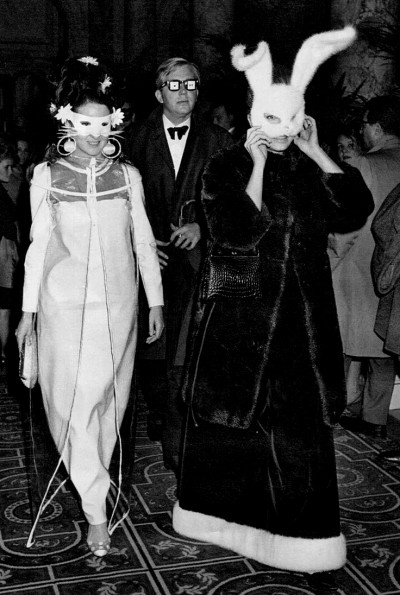
November 28, 1966    Candice also managed to get invited to the social event of the decade, the BLACK AND WHITE BALL at the Plaza Hotel in NYC.   Hosted by author Truman Capote, 540 of his elite friends attended the masquerade ball. 

The attendees mostly included the creme de la creme of New York society.  Why was Bergen included on the guest list?

                                                         Eyes Wide Shut?


https://www.esquire.com/entertainment/a32972194/truman-capote-black-white-ball-oral-history/

CANDICE BERGEN, actress: I remember faces: Frank Sinatra and Mia Farrow, ... I was a new girl in town and wasn’t really sure why I’d been invited.


"There was a guy who wore an executioner’s hood,” Bergen recalls of the party. “It got a little creepy."


https://lpcoverlover.com/2007/08/13/model-candace-bergen/                                                         Throughout the 1960’s, she would attend lavish parties thrown by the likes of CBS president William Paley.

https://maureenorth.com/1989/02/candice-bergen-plays-at-hollywood-1989-vanity-fair/                     She went from pheasant shooting on the Continent with uptight European aristocrats into the arms of her old high-school flame, Doris Day’s son, record producer Terry Melcher, one of the hippest of the L.A. hip.

May 1967 Candice appears on the cover of Vogue Magazine. (Abigail Folger's photo also appeared in a featured story in that issue.)


Candice Bergen, of course, was Terry Melcher's live-in girlfriend from about May of '67 until just after TLB happened.

Doris Day, the untold story of the girl next door by David Kaufman c.2008  pg390
Bergen moves back to the US after two years in Asia, Africa, and Europe in 1967.
"Bergen first saw Terry's house on Cielo Drive when she attended one of his parties."

June 15, 1967 Candy at Monterey Pop


 (Abigail Folger was also back stage at some point.)

Aug. 24, 1967 - Yippies throw dollar bills onto the floor of the New York Stock Exchange in a famous stunt.  Trading is briefly halted.  The group of about a dozen young men and women, including Candy Bergen, is led by radical Abbie Hoffman. The media is tipped off and is there to record it all.

Dec 1967  Candy writes article for "Esquire" 'Is BelAir Burning?' about the invasion of rock 'n roll musicians into Bel Air("Beverly Hills' snootiest neighborhood").  She meets Sonny and Cher, the Mamas and Papas and the Beach Boys and other big names. (That issue also had a picture essay of Sharon Tate titled "A Beginner's Guide to Mao Tse-Tung.")

"Inside the gate is a rose-infested bungalow housing the Bel Air Patrol, a sort of Special Forces squad of pristine policemen... ..they keep teeny-boppers away from Bel Air's celebrity residents(Elvis).. or celebrity transients(The Beatles)."  (Strangely ineffective on the night of Aug 8th, 1969, though.  If Bel Air was a 'gated community' how come nobody in the Patrol ever noticed the Watson crew coming and/or going?)


May 1968  Candice goes on tour to help with the RFK presidential run.  She also covers the 1968 presidential primaries in Oregon as a journalist.

Many sources also claim Candice is one of the celebrity ex-members of the Church of Scientology.  Her involvement was in the 1960s, at some point.


One person she apparently never met at Cielo in those years is Charles Manson.  In Knock Wood she mentions Charlie only in reference to Melcher knowing him.  And says nothing about Tex or any girls with him.  Nor does she say why she and Terry suddenly broke the lease on the house and fled to Malibu, or exactly why she and Terry felt they were the real targets, right after the murders.  No mention of any interview with the LAPD detectives.  After TLB she managed to make herself scarce:

She broke up with Terry and fled to Mexico to do a blood-soaked Western("Soldier Blue"--(critics: "set a new mark in cinematic violence"  "a bloody 1970 exploitation western ... [which] has a gore-count worthy of Cannibal Holocaust.").  And thence to Spain to film "The Hunting Party" (critics: "It is blood and more blood..." "a repellantly violent western") from June '70 until Sept '70.  (No pesky reporter's questions for the Golden girl!)

Deana Martin was subpoenaed to testify in the Tex Watson trial.  According to her, Melcher had some kind of deal with Bugliosi so she wouldn't have to testify in the TLB trial.  Candice got an even better deal.  She wasn't subpoenaed for the TLB either, and for the Watson trail she merely had to sit in the back of the courtroom with Bugs to see if she could ID Tex.  She claims she didn't recognize him. 

Knock Wood pg203  "I had been shown photos earlier in the year to see if I recognized Charles Watson... the police believed he might have been at the house on the hill while I was there. I looked at the photos; I don't think so.... When I received a subpoena to appear in court, Bugliosi arranged for me not to testify publicly, and instead sat with me in the back of the courtroom when Watson... was brought out to the defense table. Did I recognize that man? Bugliosi asked. No, I said, I didn't. All flower children look alike."    (No messy cross examination for the Golden girl!)

[Though she now admits to seeing Watson at the front door of the Cielo house in this recent interview: https://www.stitcher.com/show/awards-chatter    (29:15)      She also now admits that they broke the lease at Cielo to get away from Manson.  (worth listening too, just for Candy's obviously faked ignorance of the case)]


Interestingly, Bergen also backed away from her association with Roman and Sharon.  She does admit that Roman Polanski attended her 21st birthday party on May 9, 1967 in Los Angeles.  She does NOT mention that she attended Roman and Sharon's wedding in London on January 20, 1968.  Nor does she mention that she sent a letter to Roman while he spent a month in prison:

Jack the Great Seducer by Edward Douglas c.2004   pg182
"...Polanski was confined in Chino Prison for forty-two days(late Dec '77 to Jan '78) of psychiatric assessment prior to sentencing for having sexually abused a minor. ... Polanski received mail from Candice Bergen ..."

Did Roman and/or Sharon visit Terry and Candice while they lived at Cielo?

Roman by Roman Polanski c.1984 pg299
Terry Melcher... ... was splitting up with Candice Bergen, so their rented house off Benedict Canyon was on the market. Sharon, who had always liked it, contacted the owner, Rudy Altobelli, and we signed the lease on February 12, 1969.

Obviously Sharon, at least, had been there before, and it is likely she had been there while Terry was living there, given Candice's friendship with Roman.


 -----------------

After returning from making movies abroad, Candy takes up with radical Hollywood wunderkind/producer Bert Schneider('the Monkees' "Easy Rider").  In the spring of 1970 she attends Black Panther fundraising events.

https://www.salon.com/2012/06/09/true_hollywood_story_the_producer_and_the_black_panther/
In actress Candice Bergen's memoir, "Knock Wood," she writes about her love affair with Schneider, then in his 40s. She was still in her mid-20s. ... After his divorce, he had moved in across the narrow canyon from her cottage and lived barely 200 yards away. ...she fell for him nonetheless... He was all about "taking care of things or controlling things ... Soon he began to take care of me ..."
The ardent revolutionary who introduced his pal Huey to the likes of Jane Fonda and other luminaries...

https://www.youtube.com/watch?v=bpNOL5C9Lls                                                                                 Q:  Your life in the '60s with all these revolutionaries.  You met them all didn't you?"  
A:  I did, yes...  Bobby Seale, Huey Newton, Abbie Hoffman, Dan Ellsberg. Joan Baez .... That was in the '70s, in the '60s it was really the rock people that moved into Bel-Air....

Her affair with Schneider lasted from 1971 to about 1974.  In that time Schneider became increasingly close to Black Panther leader Huey Newton, and funded him to the tune of hundreds of thousands of dollars, back when that was real money.  In this time also Newton became a heavy user of cocaine, and ended up destroying what was left of the Panthers with his paranoia and arrogance.

https://www.salon.com/2012/06/09/true_hollywood_story_the_producer_and_the_black_panther/
What hooked her(Bergen) was the sheer force of his(Schneider's) powerful and seductive personality...   "At times, I thought he financed the Panthers single-handedly, indirectly dispatching agents of the revolution from behind his desk or beside the pool table of his Hollywood Office of Operations."
....both men were spiraling down with drugs -- free-basing cocaine was their shared drug of choice.


                                            Newton and Schneider


Candy's description of Bert sounds a lot like what the girls said of Charlie, and they seemed to have the same interests:

Knock Wood pg243   re Bert Schneider "This was what I had waited for:  a man who wanted to take care of me; a man who wouldn't take any lip." (he lives at Bergen's feet, but won't let her step on him)  His bookshelf included books by John C. Lilly**.  "The bookcase bulged with volumes on behavior modification, LSD therapy, subjugation of jealousy and maps on open marriage." 


Bergen dates Henry Kissinger.  She lays down on the floor of the U.S. Senate Building and gets arrested.  She serves as a fundraiser and organizer for George McGovern's presidential campaign.  She interviews Fidel Castro and Haile Selassie.  She travels to Red China and Esalen.

After her breakup with Schneider, Bergen hits the road again: Ethiopia, Dar es Salaam, Rio, Kyoto, Teheran.


In the '60s and '70s Candice went everywhere, met everyone, and did everything.  Successful model?  Check.  Successful actress?  Check.  Successful photojournalist and magazine writer?  Check.  Hobnobbing with European royalty, New York High Society, Rock Stars, Yippies, and Panthers?  Check.  [The daughter of a member of Bohemian Grove?  Yeah, that too.  oo-ee-oo!]

This gal was where she needed to be, when she needed to be there!  IF someone was fortuitously directing her career--the hidden hand behind her amazing success--then the question is, did this person put her at 10050 Cielo Dr. for a specific purpose?


“She’s one of the people who knows a hell of a lot more than she’s ever said” 

    --Tom O’Neill

------------------------------------------

*Was Candy a beta-kitten?  See https://hollywoodsubliminals.wordpress.com/project-monarch/sex-kitten/actresses/

"Animal Print clothing is employed for this method of communication as it symbolizes the uninhibited or “wild” instincts brought out in the slave via Project Monarch’s Beta or “Sex Kitten” Programming; and when triggered will perform any action (or sex act) required by the handler."

                                  Who took a bite out of that apple?  


**A John Lilly book was also found in the bedroom of Folger/Frykowski at Cielo.  He was into CIA sponsored mind-control in the '50s before re-emerging as a counter-cultural guru/dolphin whisperer in the '60s.


Monday, May 31, 2021

Barker Ranch - Strange RV Tours


Monday, May 24, 2021

Shorty Shea: Wrongful Death Lawsuit


March 18, 1971 a lawsuit by Phyllis Shea on behalf of herself and daughter Karen Shea was filed in Los Angeles Superior Court.  The suit named Charles Manson, Bruce Davis, Steve Grogan, John Doe Grogan, Mary Doe Grogan and Doe’s 1 through 20, inclusive as the defendants.

 The suit asks for 1.5 million to be awarded to the plaintiffs for the wrongful death of Donald Jerome “Shorty” Shea, husband of Phyllis and father to Karen.  Phyllis claims in the suit that Shorty was the sole support for her and her daughter and that she and her daughter are his sole surviving heirs.


John Doe Grogan and Mary Doe Grogan are Steve Grogan’s parents.  The plaintiff’s attorneys were not privy to Steve’s parents first names at the time the suit was filed, nor were the names ever produced during the time the suit was still “live.”  Steve was under the age of 21 when Shorty’s murder was committed therefore his parents could held financially responsible for his actions.  As an aside, Leslie Van Houten is commonly referred to as being the youngest member of the Family to be convicted of murder when, in fact, Steve Grogan was the youngest member of the Family to be charged and convicted of murder.  He had turned 18 years old about three weeks prior to Shorty’s death.  Leslie turned 20 two weeks after the LaBianca murders.

Phyllis Shea was living in Sonoma California at the time the suit was filed and she retained two Napa California attorneys to handle the lawsuit.  Both of those attorneys have since passed.  It’s quite possible that Phyllis was still married to Shorty at the time of his death.  There are no records of a divorce.  Shorty would have committed bigamy with his subsequent two marriages after Phyllis.   Shorty and Phyllis did not live together for very long after their marriage.  They were separated before daughter Karen was born.

It’s doubtful that Shorty contributed financially to Phyllis or Karen for any length of time after their break-up.  Shorty never had much money and always had trouble keeping up with his bills.  Added to that, Phyllis met another man and had four children with him between 1963 and 1969.  She later married this man in 1982 and according to her 2016 obituary they were together for 54 years.

The 76 pages of the lawsuit are not complete, you can tell that there are missing pages but they are all that I received from my request to the Archives and Records Center at the Los Angeles courthouse.  The suit was eventually dismissed in 1978 due to no parties in the suit making an appearance in court at their last scheduled court date.

PDF file download (202mb file - takes time to download)


Wednesday, May 12, 2021

Lesley Chilcott ('Helter Skelter' documentary) on the continuing fascination with Charles Manson [EXCLUSIVE VIDEO INTERVIEW]

Tony Ruiz
Emmys May 11, 2021 4:00PM


"We all wanted to do an anthropological dig into the time," declares Lesley Chilcott about the Epix documentary series "Helter Skelter: An American Myth." The series is an in-depth examination of Charles Manson and his followers culminating in the brutal murders of several people — including the actress Sharon Tate — in 1969. Chilcott, producer of acclaimed documentaries such as "Waiting for Superman" and the Oscar-winning "An Inconvenient Truth," acts as director of the six-episode series and is one of the show’s executive producers. In our exclusive video interview (watch above) Chilcott explains why it was important to avoid what she calls "the tabloid-esque coverage" of the Manson family.


Chilcott says that she took on the project in part because she never understood the public’s fascination with Manson, who died in 2017 while serving a life sentence. The director now says that it is the nature of the crimes that explains Manson’s continued presence in pop culture rather than the man himself. "I think it’s because the puzzle pieces don’t fit," she explains. "What possessed these seemingly normal boys ad girls from down the road to join what was most assuredly a cult, and some of them commit these horrific unspeakable crimes? And it’s still not understandable."

Chilcott spoke to some of those "family members" who followed Manson and readily admits that she will never fully understand the hold that Manson had on them. "On the one hand, it makes me think that it could have happened to a fair amount of people," she says. "On the other hand, it was a very unique time in history." Chilcott points to the Vietnam War, racial unrest and the invention of LSD as the perfect atmosphere for Manson’s ability to bring young people into his orbit. "You isolate [his followers] out on Spawn Ranch," she explains. "You give each person a new name. You alternate with sex and love and abuse. You keep the news and time and television away from the people. That’s what we know now as a classic cult."

In examining the political and social undercurrents of Manson’s era, Chilcott sees disturbing parallels with current society. "What we have now that we had then was that we have a lot of mayhem," she declares. "After a while, people don’t have the tools to process all of this mayhem, so they fall in and they follow a person who could be lying to them day after day but they repeat the same phrases over and over again. That’s not that different from now."

However, Chilcott emphasizes that Manson wasn’t worthy of the mythology that surrounded him in his life. "I kind of wanted to knock him off of that pedestal," she exclaims. "Number one because he doesn’t deserve a pedestal. And number two, he was a small time con artist with some really good raps and these desperate acts got out of control. He did a lot of horrible things, but was he a mastermind planner that should be idolized in that way? No."


Monday, May 3, 2021

Murderabilia or Mementos


Recently Debra Tate gave an interview to TMZ regarding items that were up for sale at Ebay proporting to be things that her sister Sharon owned. Debra claims the items are fake and never owned or worn by Sharon and she's probably correct. TMZ

Scroll through the gallery, whoever listed these items was sure asking quite a bit for the things. By the time I went to Ebay to look at the items and see who the seller was everything was taken down, presumably by Ebay. I doubt that everything would have sold in that short time. 

Correction!  Someone sent me links to the items for sale on Ebay.  I used the wrong search terms.


I find it disgusting that people would try to make money selling phony things that were supposedly related to a murder victim or some other tragedy. 

But what about selling the belongings of a victim or someone convicted of a heinous crime through a legitimate auction house where they have been authenticated. I'm talking about bona fide auction houses that do not solely sell things from convicted killers or crime scenes but places that sell all manner of items from antiques to zithers. 

 A couple of auctions that come to mind are one in Canada that sold items from the collection of Billy Jamieson in 2014 and the more recent 2019 auction of Manson related things from the estate of Nuel Emmons. In the case of the Emmons auction all of lots were accrued during the writing of his book. 

You can see the prices realized HERE , once on this page click on "Past Auctions" to see the prices.

And, there was the auction house in Georgia that sold the bed that Abigail Folger slept in at Cielo Drive. 

Debra Tate auctioned off a large number of her sister, Sharon Tate's things, too, at the very legitimate Julien's in Los Angeles. You can see the prices realized HERE


Then there are the so called Murderabilia websites Serial Killers Ink, Super Naught, Murder Auction, Redrum and others. The lots for sale at these sites are a little more dodgy and not necessarily gunuine. These sites generally deal solely in items related to killers. 

But, is there a difference between the legit auction houses and the Murderabila websites in the end? They all sell the same type of items and bank on the fact that the notoriety of the person or crime will bring big bucks to the sellers. 

Sharon's wedding dress sold to Zak Bagan's for a whopping $56,250.00 plus buyers premium and tax. He is now featuring the dress at his Las Vegas "Haunted Museum" where the price of admission is $48 per person and people stand in line for hours to enter. The dress is not displayed with Bagan's Manson booty but in a different area of the building. 

Debra was reportedly told by the auction house that "no one with morbid intentions would be allowed to purchase any of her beloved sister's items." How can the auction house make that guarantee? How can Debra not expect that when someone pays a grand or more for something that they will do what they damn well please with it? How would anyone know if an item was purchased by a straw buyer? 

There was a podcast this last week with Nancy Grace on the subject of Murderabilia with a number of people with knowledge on the subject.   Crime Stories with Nancy Grace

If you don't do Apple, just Google, it's available at other podcast websites. 

What do you think about Murderabilia? Would you buy something that belonged to a victim or killer? Would you tell anyone if you did? Do people like Emmons estate and Debra contribute to the situation by selling their loved one's things?  Do they open the door for the unscrupulous to take advantage of people?


Monday, April 26, 2021

Juanita Wildebush Speaks

The Daily Beast conducted a recent interview with Juanita Wildebush. While much of it are things we know there are a few nuggets of new information.


Charlie, Juanita, Clem, and Sadie huddled together in the back of the Dodge van that had become Juanita's traveling home in the summer of '68. Clem and Sadie made no attempt to conceal their sexual desire for each other, and soon retreated to the upper loft. Now, alone with Juanita for the first time that day at the beach, Charlie knew he had her cornered.

At 24, Juanita was a few years older than most of the free-spirited hippie girls in Charlie's orbit, but no less idealistic, and Charlie knew that. He turned to her and smiled, his eyes wide with enthusiasm, a toothy grin across his face. He slithered his small, compact frame closer to her, and kissed her. She pulled her lips away from his. "What about Carlos?" she asked, referring to her fiancé, the man she'd planned to rendezvous with in Mexico.

He giggled, that little stuttering laugh she initially found so delightful and charming but would later try to erase from memory. "You don't need to worry about Carlos, because I am him, and he is me," he said, his calm, soothing, self-assured voice settling any anxiety she may have had about what was about to happen. Then, he made love to her in the back of the van, while Clem had his way with Sadie in the bed above them. Never one to miss out on an opportunity to punctuate a moment with drama, Charlie even invited Sadie and Clem to join him and Juanita in bed together. That didn't matter much to Juanita, she was open to it, and if Charlie said it was cool, heck, it must have been.

From that moment on, Juanita Wildebush was hooked, so meeting up with Carlos in Mexico would just have to wait. Before that night at the beach was over, she'd agreed to give Charlie Manson not just her van and the $14,000 she had in a trust fund account, but her whole self.

"He was amazing," she says, describing Manson's sexual prowess to me over Zoom. Now 77, a retired social worker who spent the better part of her career helping others who, like her, have escaped a dangerous cult, Juanita lives comfortably in Oregon, a widow, mother, and grandmother. "He was so tender, he would bring you just to the point of orgasm and then he would bring you back. Like a Kama Sutra kind of thing, you know, just bring you up, and bring you up, and bring you back." I had to remind myself that she was describing the lovemaking technique of one of America's most notorious criminals, the Machiavellian cult leader who masterminded the brutal "Helter Skelter" murders in 1969 that shocked the world.

When I ask if sex was a tool Manson used to get people hooked on him, she pauses for a minute. "I think so," she says, as if realizing this for the first time, but this should come as no surprise: she's spent the last 50 years of her life running as far away from Manson as possible.

"I just don't get why this is so interesting to people," she tells me. It won't be the last time I hear her say this.

I ask her about her earliest memories of life before "Charlie." "I had a pretty unremarkable childhood," she says. "My father had had a heart attack at the end of World War II and was given 18 months to live, a year before I was born. And so there was always that undercurrent of he could die any minute. That weighed heavily on me because I was much closer to my dad than I was to my mom," she continues.

Growing up just across the river from New York City in Westwood, a modest New Jersey suburb, Juanita has fond memories of her father but had, at best, a contentious relationship with her mother. "She had a rule for everything," she says. "Like you never went into New York City without wearing gloves. You had to wear stockings. You know, there was just a rule for everything. You don't tip on alcohol. You only tip if there's table service, there were just rules, rules, rules, rules, rules, rules."

Religion was hardly center-stage in the Wildebush home. Juanita was Jewish on her father's side (her grandmother had escaped the Holocaust) but told by her mother she was Lutheran. She has no recollection of going to church or Sunday school as a child.

She starts telling me about ‘the Family' and how they're a band, how they sang with the Beach Boys. I liked her right away.

Summer camp had a profound impact on her as a teen. "It was a girls' residential camp in Vermont and it probably did more to mold me into the person I am than anything else in my life," she says enthusiastically. "It was run on the freedom program," she continues. "We all lived in cabins, two to four campers in a cabin, two on each side of a cabin, no counselor in the cabin with us. The activities were open. I'd be hot and I'd say, hey, I'm gonna go swimming. So you got to really roam free and kind of be independent and roam. "

The way she talks about the camp, it's hard not to make the connection between those early experiences and the ones she would have later with the Manson Family, in the hippie commune she discovered in Los Angeles—Charlie, with his beard, guitar, and New Age ideals, could have easily been mistaken for a Camp Director at any run-of-the-mill free-love community. Only in Manson's case, activities like horseback riding and arts and crafts would eventually take a backseat to those with a darker bent, namely, auto theft, assault, and murder.

Charles Manson was 32 years old when he was paroled from McNeil Island prison in Washington state in March of 1967. Having spent half of his life up to that point behind bars for mostly petty crimes like check forgery and pimping, Manson eventually settled in the Bay Area, where that year as many as 100,000 people converged in San Francisco's neighborhood of Haight-Ashbury for what would come to be known as the "Summer of Love." There, Manson recruited a group of young girls and formed "the Family," a roving band of bohemian nomads doing whatever possible to avoid the straight life, traveling around the country in a modified school bus in search of enlightenment.

The Family settled in the Los Angeles area, first at a flophouse in the Topanga Canyon area that separated the sprawling San Fernando Valley from the Pacific coastline, then at Beach Boy Drummer Brian Wilson's estate in Pacific Palisades, and later at Spahn Ranch, at the northwest tip of the Valley. By the time Juanita hooked up with them, the Family had grown into a full-fledged commune with Manson at the helm, dictating their every thought and action. He kept his followers isolated; at Spahn Ranch there were no newspapers, calendars, or clocks—the only information they received is what Manson wanted them to know.

"View of an upside-down car and a pair of dilapidated buildings on the Spahn Ranch property, Los Angeles County, California, August 29, 1969."

Ultimately, Manson would become a household name in December of 1969, when he and other members of the Family were arrested and ultimately convicted of the grisly Tate-LaBianca murders in August of that year. Fortunately for Juanita, by the time those murders took place, she was long gone from the Family and had no role or participation in the crimes, and has lived under the radar ever since. Now, she's one of the few remaining Manson Family members who can provide a firsthand account of what it was like to fall under Manson's spell—and to make it out safely.

Long before she hooked up with Manson, Juanita pursued an undergraduate degree at the Universidad de las Americas in Mexico City, where she met Carlos, a philosophy major at nearby Autonomous University. "He looked like Jean-Paul Belmondo. He was just dashing—he was an Olympic-caliber swimmer, so he had that swimmer's physique, good shoulders, slim hips. He knew he was brilliant, so he was a bit arrogant," she tells me.

Juanita and Carlos, along with one of his friends from school, would travel around the villages of Mexico, where they came to be known affectionately as "Los Tres" by locals; Juanita stood out with her striking looks and blond hair. Along their many travels, they encountered hippie expatriates who, like Juanita, had grown disillusioned by the political and social climate of the United States and were seeking refuge in a society less consumed with consumerism. Through them, Juanita heard stories about, and became intrigued by, the concept of communal living in the States, specifically, the Hog Farm, an organization founded by peace activist Wavy Gravy, today considered America's longest-running hippie commune and what some say Manson used as a model for his Family.

And it was in Mexico that Juanita had her first experiences with LSD. At college, she'd befriended a chemist from Sandoz Laboratory who would "show up on a Friday afternoon with a handful of pharmaceutical-grade acid pills in his pocket, lay them down on the table and say, ‘This should hold you for a while.' We'd go up into the mountains outside of Mexico City before dawn," she tells me. "We would drop our acid. We'd trip through the day. We'd come down (from the trip), then we'd go home. Yeah, it was beautiful. Just beautiful." However, her dealer friend warned her of the dangers of "street acid." Little did she know the role it would play in her life only a few short years later.

Juanita graduated from university in Mexico in 1967 with a degree in psychology and returned to New Jersey with Carlos, who after a short stay in the States retreated to Mexico with the intention of Juanita joining him there after she'd saved up enough money to purchase a van. "He had an odd view of our relationship at the time," she recalls. "He said to me, you and I are one. There is no need for me to write you. There's no need for you to write me. There's no need to call each other. We are one. But then I didn't hear from him for six months."

She worked for a time at the Aid to Dependent Children program in Patterson until she'd saved up enough money to acquire a Dodge van with a fancy sound system. Then, towards the end of the summer of '68, she bid farewell to her parents and made the cross-country trek to California with a friend in tow, whom she planned to drop in San Francisco before heading south to visit her sister's family in Palo Alto. Then, she would drive to Phoenix, visit a friend, and make her way to Mexico City to rendezvous with Carlos.

On the night before she planned to leave for Phoenix, Juanita's van was burglarized and the $850 stereo that had become her prized possession was gone. Heartbroken, she spent a few hours the next day searching for a shop that could replace it, and found one in San Jose. She kissed her sister and her nieces and nephews goodbye, loaded the van and made her way south.

After replacing the stereo in San Jose, she noticed a pregnant woman leaning against a tree near the on-ramp to the freeway, holding up a hand-written sign that said "Los Angeles." She invited the woman, and the two men with her, into the van.

The woman introduced herself as Sadie. After getting in the van, Juanita says, "she starts telling me about ‘the Family' and how they're a band, how they sang with the Beach Boys. I liked her right away."

They drove south to L.A., and Sadie directed her to Spahn Ranch, a horse property and sometimes Western movie set in the northwest corner of the San Fernando Valley, just outside the city limits of Chatsworth. By the time they arrived, it was dark out, and Sadie invited Juanita to stay for the night. "I can't wait for you to meet Charlie," she told her.

Manson's female followers were notoriously devoted to him, even after the murders, none more so than Susan "Sadie" Atkins, the troubled daughter of alcoholics and one of Manson's earliest recruits. During the trial, news outlets would broadcast startling images of Sadie, Katie, and Leslie (her co-conspirators in the Tate-LaBianca murders) parading through the halls of the courthouse, holding hands and singing Manson's songs in unison. Some of the girls, including Lynette "Squeaky" Fromme (who stayed devoted to Manson for decades even after his murder conviction), set up an encampment outside the courthouse in downtown Los Angeles during the trial, where they could be seen sitting cross-legged on the ground, often singing Manson's praises to anyone willing to listen. When Manson appeared in court with an "x" carved into his forehead and his scalp shaved, many of the girls followed suit. To them, Manson and God were synonymous, and law enforcement's attempts to "crucify" him were only further proof to them that he was, in fact, Jesus incarnate.

Charlie Manson, as Juanita had already learned from her conversation with the hitchhikers, was the leader of Sadie's band. When they arrived at Spahn Ranch after dark, Juanita followed Sadie towards a trailer off to the side of the faux-Western "town" in the center of the ranch. "Charlie! Charlie! Look what we found you!" Sadie yelled out as they approached the trailer. The trailer door opened and out popped a naked man, no more than five feet two inches, grinning from ear to ear, accompanied by his naked lover, a beautiful brunette who went by the name "Gypsy." "They welcomed me in, handed me a joint and asked me if I wanted some tea," she says.

At the ranch, she found herself in the company of warm people just like her, disillusioned with the world as they saw it, more interested in peace and love than material wealth. They were the kind of people she'd been looking for; they shared the same values, they spoke the same language.

That night, "we talked, we hung out, they sang for a while. And then everybody went to bed and Charlie invited himself into my van. And I said, no. I mean, I just met the guy." I ask her if she was taken back by his forwardness. "It's hard to explain what the hippie life was like to somebody who didn't believe it," she tells me, "but it was just all open and free-flowing and you just, you know, you just went where the wind blew you. You know, and that was what you were supposed to do, because the universe would provide."

Still, she rejected Manson's overt advances. "Well, now you're just being selfish," he told her. "But we're gonna fix that."

The next morning, Juanita awoke in her van to a bowl of oatmeal with raisins and brown sugar being offered to her by one of the girls. Moments later, Manson appeared with two cups of coffee to choose from, one with and one without cream. Juanita recalls the image in her mind. "He said, ‘Come on, let's show you around.' "And that's when I got out of the van and I looked around, and it was magical. It was like, hey, I've got a movie set. Look at all those horses. Look at the cowboys over there." I ask if her first impressions of the ranch reminded her of summer camp. She doesn't hesitate. "Yeah, it sort of did."

Spahn Ranch in the Manson years is reported to have had a similar effect on other outsiders who encountered it. Greg Jakobson, a songwriting partner of Beach Boy Dennis Wilson (who invited Manson to live with him in the summer of '68 and nicknamed him "the Wizard"), was so taken by Manson's Svengali-like hold over the young girls in his midst, he tried to convince his friend, record producer (and future Manson foe) Terry Melcher, to finance a documentary about the Family. There's no doubt the ranch would have been an assault on the senses for anyone experiencing it for the first time. The setting was a rustic, boulder-strewn canyon; the sights included horses, ranch hands and a gaggle of LSD-infused hippies cohabiting amidst a decrepit Western movie set; sage and jasmine and eucalyptus perfumed the air. While only 10 miles from the sprawl of Los Angeles, the ranch, with its idyllic location at the foot of the Santa Susana mountain range, was nothing short of an oasis; even today, the terrain feels better suited for a high-end resort than what lies just beyond it.

Ingratiating herself with the group, Juanita found it harder and harder to leave with each passing day. Had she found the utopia she'd been looking for since her days wandering around Mexico as part of "Los Tres"? "I had this pre-formed thing of what life on a commune in the States would be," she recalls. "And all of a sudden I was on a commune in the States, so I was really interested in it. And I kept thinking, oh, God, I should write to Carlos and have him come up here." But that never happened.

One night at Spahn Ranch, Manson organized a group LSD trip in the house they shared together. Once the drug took hold, things spiraled out of control. She describes it to me: "I can still remember it, it was like I was in this Arabian tent, there's Arabian Nights kind of scene and there were pillows everywhere and horses jumping through and people were fighting and yelling, it was really chaotic. And Charlie came in to where I was because I was just watching it and said, ‘I got to find my shoes. I've got to get out of here.' And I stood up and asked him, ‘Where are you going?' And he said, ‘I have to leave, all the love here has gone. I don't know what happened, but I'm leaving.'"

At one point, Family member "Little Paul" Watkins punched her square in the jaw, so she walked out of the house to get some fresh air. One of the male members of the Family followed her out and asked where she was going. "I don't want to go back in there," she told him.

He told her to stay put. The next day, with Manson missing from the ranch, Juanita shared her conversation with him with the Family, and they grew concerned about the whereabouts of their leader. Then, as if nothing had happened, Manson arrived back at the ranch later that afternoon, and the incident was soon forgotten.

"Little" Paul Watkins was, by all accounts, Manson's right-hand man—his best recruiter and a personal favorite among the female members of the Family. When Family members (including Juanita) began defecting from the group of '69, it was Little Paul who initially dug his heels in, boldly confronting anyone who dared challenge Manson's theory on the impending race war, something Charlie called "Helter Skelter," named after the song on the Beatles' White Album he'd become obsessed with. Later, Little Paul would be among those who testified for the prosecution at Manson's trial, sharing details of his former guru's dark philosophies to a shocked courtroom: "There would be some atrocious murders; that some of the sp--es from Watts would come up into the Bel-Air and Beverly Hills district and just really wipe some people out," he said, using racist slang, "just cut bodies up and smear blood and write things on the wall in blood, and cut little boys up and make parents watch."

In November of '68, the Family loaded up the old school bus they had outfitted as their primary means of transportation and set out for the Mojave Desert. They'd learned of the remote Meyers Ranch, a miners' outpost deep in Golar Canyon in the southwest corner of Death Valley National Park. Family member Kathy Giles' grandmother owned the ranch, and they initially planned to set up an encampment there. Manson often shared with the group his fascination with the desert. He believed its vast, empty landscape would provide fewer distractions for his growing Family.

Upon reaching the base of Golar Canyon, they attempted to navigate the bus through the narrow, dusty road that led to the ranch but it proved no match for the rocky terrain, so the Family found themselves hauling their gear up the wash on foot. At this point, Juanita became startled by the sound of bombs exploding in the distance and flashes of light across the sky. "I freaked out," she explains. "We were traveling that day and I absolutely freaked out, ducked my head, covered. It was the scariest thing I had ever been through. And they helped me get up."

Years later, she would visit a psychic medium who would tell her that in a previous life, she'd been a 13-year-old Jewish boy who was smuggled out of Belgium by nuns to escape the Nazis, and the sound of bombing she'd heard that day in the canyon had triggered memories of those events. Later, she would identify the actual source of the sounds: the Naval Weapons Air Station at China Lake, some 20 miles from the canyon.

When it became apparent that Meyers Ranch wouldn't provide enough space for the Family, which by now had swelled to over 30 members, they opted instead to stay at nearby Barker Ranch, which offered more expansive accommodations. They settled into their new life in the desert. By day, Manson would send the Family out to search for a secret cave, the "bottomless pit" that would lead the Family to an "underground city" where they could hide out during the forthcoming race war. At night, they'd drop acid and sit around the campfire singing and listening to Manson preach. Some nights he'd try to orchestrate a group orgy, which never quite materialized.

After a week or two at the ranch, Manson dispatched Juanita and Family members Diane Lake ("Snake") and Little Paul Watkins to Las Vegas to drum up supplies for the group. They spent a few days there fundraising, going door to door and introducing themselves as members of the Delta Delta Delta sorority, collecting food for hungry people in the desert.

On their way back to Barker Ranch, they stopped in Shoshone, a dusty desert outpost on the banks of the Amargosa River not far from Golar Canyon, to panhandle and pick up more supplies. There, they came face to face with Inyo County Sheriff Don Ward, a small bulldog of a man whose children attended the local schools and who'd grown concerned about the hippie contingent infesting his otherwise conservative community. He offered them a simple piece of advice: "Get out, and don't come back."

Fast-forward to March of 1969. Manson and the rest of the Family had gone back to Spahn Ranch to continue preparing for the inevitable race war—spending the majority of their time building dune buggies and "fundraising" to finance their retreat to the desert.

Juanita, along with a relatively new Family member, 19-year old Brooks Poston, had been left behind at Barker Ranch, directed by Manson to "keep an eye on the place." Though the Family told them they would be back to get them in 10 days, they'd been separated from the Family for three months. But then, two unexpected visitors showed up at the ranch in a Dodge Power Wagon.

The men, Paul Crockett and Bob Berry, introduced themselves as gold prospectors from New Mexico looking for a place to stay while they set up their operation in the abandoned mines scattered around the Panamint Mountain range.

"You can't stay here," Juanita told them.

Crockett, the older of the two, took charge. "It's getting dark, code of the desert is you take care of us and we'll leave when it's daylight," he said. "And they offered us food, and we were running low on food, so we all cooked, and we ate together that first night," she recalls.

The next day came and went, and it soon became apparent the prospectors, now living in the small "bunkhouse" about 50 yards away from the main house at Barker Ranch, weren't going anywhere. "We were wondering how the hell we were going to get rid of them before Charlie came back," Juanita says.

Crockett, somewhat of a stoic figure, took a liking to her and Brooks. Despite their urging him to leave, after long days collecting ore samples at the mines, he would join them at night, along with Bob, for dinner and company in the main cabin. "We would sit around the kitchen. Brooks had a four-string guitar, we would sing, and it wasn't very long into this that we started playing metaphysical games," she says. "Paul taught us how to create energy balls in our hands, hold it there long enough and we would throw the ball around the kitchen to each other, sort of like playing keep away, but with an energy ball."

The more he got to know Juanita and Brooks, the more Crockett learned about them, the Family, and "Charlie," whom they seemed afraid of. They learned about him, too—he told them stories about his mentor, "Doc" Bailey, a student of L. Ron Hubbard who used a machine to help his patients overcome their physical pain through the use of electro-magnetic energy. And he talked about "agreements," "hundreds of agreements that we make with other people, and it's the implied agreements that are the strongest," she says, no doubt referring to their precarious relationship with Manson.

Juanita tells me that Crockett picked up on their concern about "outsiders" at Barker Ranch. "Paul said, ‘I can fix that. We can fix that together.' And I said, ‘What do we have to do?' He says, ‘Let's go back down to the wash' (the point of entry into Golar Canyon). We get there, and he says, ‘Just imagine an arch made of energy that fills that wash. And on the arch, it says all those who pass this point must be prepared to pay their karmic debts.' And so we visualized that. We put it up. And people stopped coming. Later, Little Paul told us that Charlie had tried to come up many times and he'd get so far, and he couldn't get up any further."

As images of the gory crime scenes flashed across the screen, Juanita felt a pit in her stomach, and turned to Bob. ‘That's Charlie. That's the Family.'

By now convinced that Crockett had special powers over Charlie Manson, Juanita and Brooks began to join him and Bob on their prospecting excursions into the mountains. Juanita jumped at the opportunity to learn a new trade. "We're all prospecting," she says. "We had our claims staked."

They would pack what little gold they found into small vials and take them to Las Vegas, where they could sell the gold for three times its value in the back of a Chinese restaurant.

Meanwhile, Juanita and Bob Berry developed a romantic relationship, after Bob volunteered to stake out a wild cougar that began showing up at the ranch during the night, and Juanita offered to keep him company.

Eventually, Little Paul and Family member Barbara Hoyt (Bo) made it through the energy field and arrived back at the ranch to fetch Brooks and Juanita and bring them back to L.A. Upon their arrival, Little Paul was shocked to learn that they'd taken up with the two prospectors, more so when they confided in him that they'd decided to leave the Family. Little Paul, in his best efforts to emulate Manson, went to work on Crockett, warning him of the coming race war and all that might befall him if he didn't get "hip" to the scene. Seeing his efforts have little to no effect on Crockett, Little Paul soon became convinced that Crockett had power, perhaps more so than his beloved Charlie, and began talking of defecting from the Family himself and hooking up with Crockett's prospecting venture. But those plans would have to wait—Little Paul had promised Manson he'd come back to Los Angeles and he intended to honor his commitment. So he and Bo bid farewell to Brooks and Juanita, but not before they asked him for a favor.

"When he was leaving, we said, (Little) Paul, will you do us a favor? Some evening when Charlie and everybody are together in the living room, would you tell Charlie that we want him to release us from all agreements implied or direct? And we will do the same for him. And so Little Paul, I guess, went back and did it, and Charlie said something like, ‘That's fine. I don't care.'"

Polish film director Roman Polanski, fresh on the heels of the success of his first Hollywood production, the 1968 horror film "Rosemary's Baby," moved into the ranch-style house in Bel Air at 10050 Cielo Drive with his new wife, the up-and-coming young actress Sharon Tate, in February of 1969. The house had previously belonged to music producer Terry Melcher, whom Manson had crossed paths with a number of times through his Dennis Wilson connection.

On the evening of Aug. 8, 1969, Manson instructed family member Charles "Tex" Watson to take Sadie, Katie, and Family newcomer Linda Kasabian to "that house where Melcher used to live" and "totally destroy" everyone in it, and to do it "as gruesome as you can."

At the house that night were Tate, 8½ months pregnant with Polanski's baby (he was in Europe working on a film); her ex-boyfriend, the flamboyant hairstylist to the stars, Jay Sebring; screenwriter Wojciech Frykowski; and Frykowski's girlfriend Abigail Folger, heiress to the Folgers coffee fortune.

When police were called to the scene the next morning, after Polanski's housekeeper discovered the bodies of Frykowski and Folger on the lawn outside the house, they discovered a ghastly scene that looked like something out of one of Polanski's movies, with blood splattered throughout the house, and Tate's body on the ground with a noose around her neck and her stomach cut open. There was even a cryptic message left behind by the killer(s) on the front door: the word "PIG" written in blood.

The following night, grocery store owner Leo LaBianca and his wife Rosemary were murdered in their Los Feliz home in a similar fashion, and the entire city of Los Angeles went into panic mode, certain they'd been targeted by a serial killer of one form or another. It wouldn't be until December of that year that they'd learn the identity of the killers: a group of drug-induced hippies, members of a religious cult operating inconspicuously in the shadows of the City of Angels.

After she freed herself from Manson, Juanita set about moving forward with her life. At one point, a prospector nicknamed "Heavy" paid a visit to Barker Ranch. When he mentioned to Bob that he was a Justice of the Peace, Bob asked if he would marry him and Juanita, since he had all of the paperwork and could file it at the court in Independence, the seat of Inyo County some 200 miles from the ranch, and he agreed to do it. "I didn't have a dress," Juanita says. "I just had what I had been wearing. I took the curtains off the windows (of the school bus) and turned them into a dress."

Meanwhile, Bob's brother, also a prospector, had a line on an opportunity to mine for turquoise in Arizona, and brought the news to Barker Ranch. With the Golar Canyon operation yielding minimal results, the newlyweds decided to try their luck elsewhere and left Brooks and Crockett behind to carry on without them.

In August of that year, Juanita, Bob and some friends were sitting around a TV in Kingman, Arizona, watching news of the moon landing when a special bulletin about a series of gruesome murders in the L.A. area appeared on the screen. As images of the gory crime scenes flashed across the screen, Juanita felt a pit in her stomach, and turned to Bob. "That's Charlie. That's the Family," she said, though it would be months before investigators would link Charles Manson and his group to the crimes.

Little Paul eventually made it back to Barker Ranch and hooked up with Crockett and Brooks, fully ready to cut ties with Manson. In late September, Manson and the remaining members of the Family finally made it through the energy field and settled in at Meyers Ranch, initiating a stand-off of sorts with Crockett and his camp at Barker.

Manson did his best to woo the hardened prospector to him, but Crockett held his ground. Eager to continue his prospecting in the area, he agreed to offer his assistance to Manson and began bringing supplies up to the ranch in his Power Wagon from the valley below.

At the same time, Sheriff Ward began to grow suspicious of Manson's activities in and around the desert, believing them to be criminal in nature. One day while exploring the area, Ward happened across Crockett, who was en route back to the ranch with a truck bed full of supplies. Initially reluctant, Crockett agreed to talk with Ward about what he knew, and told him everything, furthering Ward's suspicions; by now, Ward was devoting all of the resources at his disposal to take Manson down.

That day would come in October, when park rangers discovered one of their earthmovers had been set ablaze deep in the desert, and followed tire tracks from the smoldering heap straight to Golar Canyon. Crockett, having been told by Manson that he "should be more afraid of me than the law," decided he'd gone about as far as he could at Barker Ranch, and escaped with Brooks over Mengle Pass into Shoshone, where they hooked up with Sheriff Ward, who committed their testimony to tape.

The law descended on Barker Ranch shortly thereafter and arrested Manson and his followers, booking them in jail in Independence on an arson charge. On his arrest report, Manson signed his name "Manson, Charles M., aka Jesus Christ, God." It wouldn't be until December that Ward would learn that the hippies he'd arrested for setting fire to an earthmover were guilty of crimes far worse than that.

Manson, Sadie, Katie (real name Patrica Krenwinkle), Leslie (Van Houten) and Tex, were ultimately convicted for their roles in the Tate-LaBianca murders. Initially all received a death sentence, however, in 1972, those sentences were commuted to life in prison (with the possibility of parole) after the Supreme Court of California ruled that the state's death penalty laws were unconstitutional.

Sadie died in prison from brain cancer in 2009, at age 61, after having been denied parole 14 times. Manson remained in prison until his death at age 82 on Nov. 19, 2017 from cardiac arrest.

That's what the survivor's guilt was about. I had no doubt that had I been there, I would have done (the same thing).
Katie and Leslie remain incarcerated and have been denied parole 14 and 22 times, respectively. Tex, a born-again Christian, also remains incarcerated, having been denied parole 17 times, most recently in 2016.

On Sept. 9, 1971, as Barbara "Bo" Hoyt was preparing to board a flight from Hawaii back to California where she was to testify for the prosecution in the Helter Skelter murder trial, Family member Ruth Anne Moorehouse bought her a hamburger and laced it with a multi-dose of LSD in an attempt to kill her. Hoyt survived and testified at the trial, and Moorehouse, along with four other Family members, were later charged with attempted murder. Hoyt died in 2017 at age 65.

Brooks Poston testified for the prosecution during the trial, helping to explain to the jury the Helter Skelter motive. After the trial, he formed a musical group called Desert Sun with Paul Watkins and performed in Inyo County, California. He eventually followed Paul Crockett to Washington, where he still lives today.

Little Paul Watkins went on to become the founder and first president of the Death Valley Chamber of Commerce and the unofficial mayor of the small town of Tecopa before his death in 1990 from leukemia. He is survived by his second wife and their two daughters, one of whom is the writer Claire Vaye Watkins.

After his confrontation with Manson, Paul Crockett settled into life in the desert and for a period of time, acted as the manager for Brooks and Paul's band. He eventually married his wife of 30 years, Sylvee, and moved to Washington where he started a metaphysical coaching practice, Balance Point School for Personal Evolution. In a 2012 radio interview, Crockett was asked about his time with Brooks and Juanita in the desert, and the deprogramming he did for them. "They were hungry, they were sharing our food," he told the interviewer. "And so later on, it became obvious that they sold out to me for a bologna sandwich." Crockett died on Jan. 10, 2014, at age 89.

As for Juanita, she is content to leave the events of '68-'69 where she thinks they belong—in the past. She stayed married to Bob until his death two years ago, and they had one son together, who now has his own family. Now retired, she built a successful career working as a licensed therapist and has received high esteem from her colleagues for her work with cult survivors. She is lovely, whip-smart, and very funny. I ask her, with the passing of time, if she ever thought about Sadie or any of the other girls she befriended in the Family. "That's what the survivor's guilt was about. I had no doubt that had I been there, I would have done (the same thing). Sadie and Leslie were the people I felt the closest to," she tells me candidly. She even admits that she considered visiting Sadie in prison at one point, though her therapist talked her out of it.

Today, she is a committed and practicing member of the Jewish faith. She often thinks back to the day she first hiked into Barker Ranch when she heard the sound of bombs and wonders if the psychic medium might have been right—she thinks perhaps she was a young Jewish boy in another life.

Very few people in Juanita's orbit know about her time with Charlie and the Family; she has not even shared her past with her neighbors who she regularly socializes with. When she tells me her story, she's remarkably detached from it, but I can tell it still affects her to a degree. I ask her about that. "(I'm hopeful) something good will come out of putting myself out there in a way where it makes me feel better about this whole thing. That like by putting myself out there, I'm breaking the shackles off of me and I'm no longer constrained by this thing, that I have control over it and it doesn't have control over me."

In one of our conversations, I ask Juanita about Carlos. "What ever happened to him?"

She laughs. "Who knows. For all I know, he's still in Mexico, waiting for me."